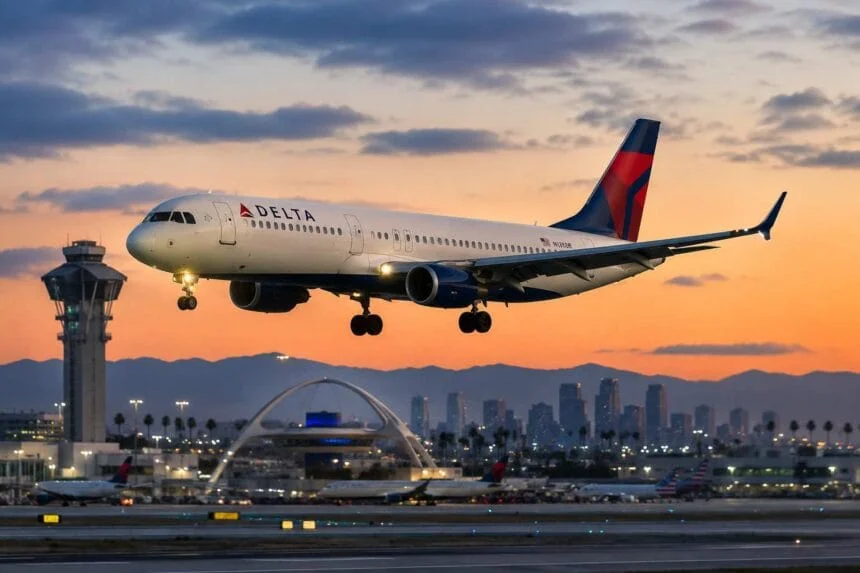
Delta Flight DL275, operating from Detroit Metropolitan Wayne County Airport (DTW) to Tokyo-Haneda (HND), diverted to Los Angeles International Airport (LAX) due to a reported engine anti-ice system malfunction. The flight carried more than 300 passengers aboard an Airbus A350-900 on a transpacific route spanning approximately 13 hours. The crew made a precautionary decision to reroute before reaching remote oceanic airspace, prioritizing safety margins over schedule.
- What Was Delta Flight DL275?
- Why Delta Flight DL275 Diverted to LAX Got Attention
- Why Did Delta Flight DL275 Divert to LAX?
- Why LAX Was the Optimal Diversion Airport
- The Aircraft Involved — Airbus A350-900
- Passenger Experience After the Diversion
- Aviation Safety Lessons from the DL275 Diversion
- Conclusion
- Frequently Asked Questions
- What was Delta Flight DL275?
- Why did Delta Flight DL275 divert to LAX?
- Was Delta Flight DL275 an emergency landing?
- What aircraft operated Delta Flight DL275?
- Were any passengers or crew injured on Delta Flight DL275?
- Why is the engine anti-ice system important on long-haul flights?
- Why did DL275 divert to Los Angeles instead of continuing to Tokyo?
- How does Delta support passengers during a flight diversion?
Contents
What Was Delta Flight DL275?
DL275 is a Delta Air Lines international scheduled service connecting Detroit and Tokyo-Haneda. The route crosses the North Pacific using northern airspace corridors, which are standard for long-haul transpacific operations. At cruising altitude over remote stretches of ocean and Alaska, the aircraft is far from any immediate diversion point, making early crew decisions especially critical.

The Route from Detroit to Tokyo-Haneda
The DTW–HND corridor follows a great circle path across the North Pacific. This routing takes the aircraft over isolated, often frozen airspace where ground support, alternate airports, and rapid maintenance access are limited. Engine function and anti-icing reliability are not optional on this route; they are foundational to safe completion.
Weather exposure along this corridor includes freezing temperatures, high-altitude moisture, and the risk of ice accumulation. Any system designed to protect against these conditions places a significant operational burden on long-haul transpacific flights.
Why Delta Flight DL275 Diverted to LAX Got Attention
Flight tracking platforms flagged the route change in real time. Aviation communities noticed the aircraft’s path shift from its expected transpacific heading toward the California coast. News outlets quickly picked up the story, largely because diversions involving wide-body jets on international routes are uncommon and generate genuine public interest.
The reroute from a Japan-bound flight to a California landing drew attention not because it indicated danger, but because the deviation was visible, trackable, and unexpected.
Why Did Delta Flight DL275 Divert to LAX?
The reported cause was a malfunction in the engine anti-ice system. This system prevents ice from forming on critical engine components during flight. When it fails or behaves abnormally, the crew must assess whether continuing into high-risk icing environments — such as those over the North Pacific — is appropriate.
The crew determined that pressing on into oceanic airspace with a compromised anti-ice system fell outside acceptable safety margins. LAX was selected as the diversion point while the aircraft was still within range of major infrastructure.
Understanding the Engine Anti-Ice System
Ground de-icing before takeoff handles snow, frost, and ice on the aircraft’s exterior surfaces. The engine anti-ice system operates in flight, protecting internal engine components from ice accumulation caused by moisture and freezing temperatures at altitude.
When air enters the engine at high altitude, it can carry moisture that freezes on inlet components. Ice buildup restricts airflow, degrades engine performance, and in serious cases can cause engine damage or flameout. The anti-ice system heats critical areas to prevent this from happening.
On a 13-hour transpacific crossing, that system needs to function reliably for the full duration.
Why LAX Was the Optimal Diversion Airport
Los Angeles International Airport offered several clear advantages as a diversion destination:
| Factor | Why It Mattered |
| Delta facilities and maintenance | Capable of servicing wide-body aircraft like the A350-900 |
| 24/7 operations | No restrictions on late or unscheduled arrivals |
| Passenger services | Hotels, rebooking desks, and food services are readily available |
| Fuel planning capacity | Sufficient infrastructure for a fully-loaded transpacific aircraft |
| Onward connections | Multiple options for passengers continuing to Tokyo |
Diverting to a smaller or less-equipped airport would have complicated maintenance access, delayed passenger support, and extended the overall disruption window.
The Aircraft Involved — Airbus A350-900
The aircraft operating DL275 was an Airbus A350-900, registered as N508DN. The A350-900 is a wide-body, long-range aircraft designed specifically for routes like DTW–HND. It offers advanced cockpit technology, high fuel efficiency, and passenger comfort systems suited for extended international operations.
Delta Air Lines operates multiple A350-900s on transpacific routes, and the type is well-regarded for reliability. The involvement of this specific airframe in a diversion is notable precisely because the aircraft is not prone to frequent technical issues.
Why Aircraft Type Matters in a Diversion
Not every airport can handle every aircraft. The A350-900 requires trained maintenance staff familiar with its systems, as well as the availability of specific parts and compatible ground equipment. LAX, as a major international hub with Delta maintenance infrastructure, could meet those requirements.
A diversion to an airport without proper A350 support would have created delays waiting for mobile maintenance teams or parts to be flown in. Choosing LAX eliminated that variable from the start.
Onboard Safety Systems and Early Detection
The A350-900 is equipped with advanced monitoring systems that track engine performance and alert the crew to anomalies before they become emergencies. In this case, the system warning allowed the crew to identify the anti-ice issue, run their procedures, and make a diversion decision. At the same time, the aircraft was still in a manageable position.
Early detection is not a minor detail — it is the mechanism that converts a potential problem into a controlled, uneventful landing. Modern aviation technology exists specifically to compress the time between anomaly and crew response.
Passenger Experience After the Diversion
Passengers aboard DL275 landed safely at LAX with zero injuries reported. The disruption, however, was real. Travelers on a Detroit-to-Tokyo itinerary suddenly found themselves in Los Angeles, facing missed connections, schedule uncertainty, and an unplanned overnight stay.
That said, a safe landing is the primary outcome. Everything after that is logistics.
Hotel, Meals, and Rebooking Support
Delta’s standard disruption protocols cover the core needs:
- Hotel arrangements for passengers requiring overnight accommodation
- Meal vouchers for immediate needs at the airport
- Rebooking onto the next available DTW–HND or connecting service
- Onward travel options for passengers with flexible itineraries
The quality of these services varies based on staffing, hotel availability, and demand at the time of diversion. Passengers who communicated directly with Delta agents at the gate or via the Delta app generally experienced faster resolution.
Why Crew Communication Matters During a Diversion
When the flight path changes unexpectedly, passengers notice immediately. Without clear communication, confusion turns into anxiety, and anxiety turns into frustration that compounds every subsequent step.
Direct crew announcements — explaining what happened, where the aircraft is heading, and what passengers should expect — significantly reduce that friction. Transparency during a diversion not only manages emotions but also builds trust in the airline’s handling of the situation.
Passengers who understood the reason for the diversion were better prepared for the process that followed.
Aviation Safety Lessons from the DL275 Diversion
The DL275 diversion illustrates a fundamental principle of modern aviation risk management: the system works because crews act on early information rather than waiting for confirmation of a full emergency.
A Diversion Is a Safety Tool, Not a Failure
Diverting is not an indication that something went seriously wrong. It is proof that the safety system functioned correctly. The crew detected an anomaly, assessed the risk of continuing into oceanic airspace, and chose the conservative path.
Precautionary landings prevent escalation. A technical fault that is manageable at LAX with full maintenance access becomes significantly harder to manage mid-Pacific with limited options. The decision to divert early is the decision that keeps passengers safe.
Long-Haul Flights and Extra Caution Over Remote Airspace
Oceanic airspace changes the risk calculation for any technical issue. Over the North Pacific, the nearest diversion airport can be an hour or more away. Crew action taken early — while still within range of major infrastructure — preserves options that disappear as the flight moves farther from land.
Long-haul operations demand higher safety margins precisely because the consequences of waiting are greater. The DL275 crew followed that standard correctly.
Conclusion
Delta Flight DL275 diverted to LAX after the crew identified a malfunction in the engine anti-ice system before the aircraft entered remote transpacific airspace. The Airbus A350-900 landed safely, passengers were protected, and no injuries occurred. The decision reflected sound crew judgment and adherence to aviation safety standards. Diversions of this kind are not failures — they are the system performing exactly as designed.
Frequently Asked Questions
What was Delta Flight DL275?
Delta Flight DL275 was a scheduled international service operated by Delta Air Lines between Detroit Metropolitan Wayne County Airport (DTW) and Tokyo-Haneda (HND), flown aboard an Airbus A350-900.
Why did Delta Flight DL275 divert to LAX?
The crew reported a malfunction in the engine anti-ice system. To avoid entering remote oceanic airspace with a compromised system, they made a precautionary diversion to Los Angeles International Airport.
Was Delta Flight DL275 an emergency landing?
No. The diversion was precautionary, not an emergency. There was no immediate danger declared. The crew followed standard procedures for a technical fault identified before reaching oceanic airspace.
What aircraft operated Delta Flight DL275?
The flight used an Airbus A350-900, registered N508DN — a wide-body, long-range aircraft designed for transpacific international operations.
Were any passengers or crew injured on Delta Flight DL275?
No. The aircraft landed safely at LAX with zero injuries to passengers or crew.
Why is the engine anti-ice system important on long-haul flights?
It prevents ice from forming on engine components at altitude. Ice buildup can restrict airflow and reduce engine performance. On a 13-hour transpacific crossing, the system must remain reliable for the entire flight.
Why did DL275 divert to Los Angeles instead of continuing to Tokyo?
LAX offered Delta maintenance infrastructure, 24/7 operations, and full passenger support services. It was reachable before the flight entered the most isolated stretch of Pacific airspace.
How does Delta support passengers during a flight diversion?
Delta provides hotel accommodation, meal vouchers, rebooking assistance, and onward travel options. Passengers are advised to contact Delta agents directly or use the Delta app for the fastest resolution.