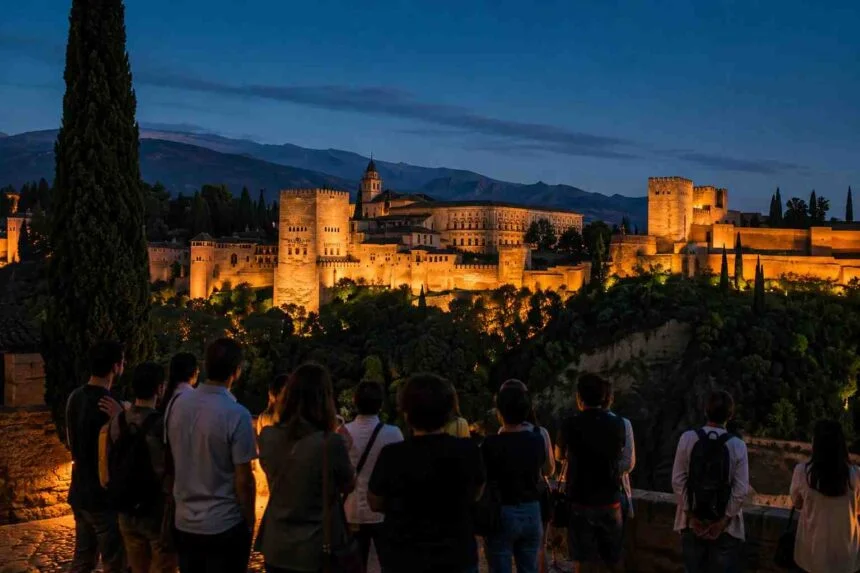
Alhambra night tour attendance revenue is the income the Patronato de la Alhambra y Generalife earns from evening visitor access to the monument — mainly through timed-entry tickets, guided experiences, and add-on services. Unlike most tourist attractions, this revenue isn’t driven by visitor volume. UNESCO conservation rules cap how many people can enter each night, so income depends far more on pricing strategy, seasonal demand, and premium service offerings than on simply selling more tickets.
- What Is Alhambra Night Tour Attendance Revenue?
- The Alhambra Night Tour Experience
- Why Night Tours Exist: Overtourism and Carrying Capacity
- Attendance Trends and Visitor Patterns
- Ticket Pricing Strategy
- Revenue Streams Beyond Ticket Sales
- Revenue Allocation and Conservation Funding
- Economic Impact on Granada’s Tourism Ecosystem
- Conservation vs Commercialization
- Technology in Crowd and Revenue Management
- Future Outlook and Growth Trends
- How to Maximize Your Night Tour Visit
- Pros and Cons of Alhambra Night Tours
- Common Mistakes in Managing Night Tour Revenue
- Conclusion
- FAQs
That distinction matters for anyone studying the Alhambra’s tourism model, whether you’re researching cultural heritage economics, planning a visit, or comparing revenue strategies across protected sites. The numbers tell a story about scarcity, not scale.
What Is Alhambra Night Tour Attendance Revenue?
At its core, this figure represents the total financial return generated from nighttime access to the Nasrid Palaces and Generalife gardens. It combines ticket sales with guided tours, audio guide rentals, and private VIP experiences.
A simple way to frame it:
Attendance Revenue = Number of Night Visitors × Average Ticket Price + Premium Services
Because the visitor count side of that equation can’t grow past a fixed ceiling, the price and services side carries most of the weight. This is the opposite of how a theme park or large museum typically grows revenue — those venues expand by adding capacity. The Alhambra expands by adding value per visitor instead.
Quick Facts Overview
| Category | Details |
| Location | Granada, Spain |
| Site Type | UNESCO World Heritage Site |
| Main Areas Accessed | Nasrid Palaces, selected Generalife sections |
| Managing Authority | Patronato de la Alhambra y Generalife |
| Ticket Type | Timed-entry night tours |
| Standard Ticket Price | Roughly €8–€10 |
| Revenue Sources | Tickets, guided tours, audio guides, VIP experiences |
| Attendance Model | Strictly limited capacity |
| Peak Seasons | Spring (March–May), Autumn (September–October) |
| Low Season | Winter months |
The Alhambra Night Tour Experience
Night visits feel completely different from a daytime walkthrough. Inside the Nasrid Palaces, lighting is kept low and warm, echoing the torchlight and oil lamps that would have lit these rooms in the 14th century. In spaces like the Hall of the Abencerrajes and the Court of the Two Sisters, shadow plays a deliberate role — it’s part of the design, not an accident of timing.
The Court of the Myrtles takes on a different character after dark too. Without the daytime crowds and bright sun, its reflecting pool turns into a still, dark mirror. Visitors who’ve done both tours often say the night version feels less like sightseeing and more like stepping into the building’s original atmosphere.
This is why the night tour isn’t marketed as a fallback option for people who missed daytime tickets. It’s sold and perceived as its own premium product — one that draws repeat visitors who already toured the palace in daylight and want the contrast.
Why Night Tours Exist: Overtourism and Carrying Capacity
Night tours weren’t created purely for revenue. They started as a response to a capacity problem.
By the late 1990s and early 2000s, daytime crowds at the Alhambra were creating real conservation issues — rising humidity, CO2 buildup, and physical wear on floors that are roughly 800 years old. The Patronato became one of the first heritage management bodies in Europe to apply a formal tourist carrying capacity model, limiting how many people could be inside the Nasrid Palaces at once.
With only about 2,100 square meters of palace interior available for foot traffic, and an average visit running close to 45 minutes, daytime ticket sales topped out around 350 entries every half hour. That cap protected the building, but it also meant turning away paying visitors and unmet demand.
Opening the site after dark solved part of that problem. It spread total daily visitors across a longer window without raising the instantaneous number of people inside the palace at any one moment — the actual conservation risk. What began as a pressure-relief measure for overtourism turned into one of the site’s more profitable offerings.
Attendance Trends and Visitor Patterns
The Alhambra draws several million visitors a year overall, and night tour attendance follows its own rhythm — shaped more by comfort and travel patterns than by headline tourist season alone.
Seasonal Demand Fluctuations
- Spring (March–May) and Autumn (September–October): The strongest demand windows. Mild weather and heavy international travel combine to push night tours close to full booking.
- Summer (June–September): Daytime temperatures in Granada regularly climb past 40°C (104°F), which actually pushes more visitors toward the cooler evening slots. Night tour demand spikes even though it’s traditionally considered shoulder behavior for most attractions.
- Winter (December–February): The quietest period. Attendance holds up reasonably well among domestic tourists and travelers drawn to Granada’s colder, quieter evening atmosphere, but it’s well below spring and autumn levels.
Visitor Demographics
Night tour attendees skew differently than the general daytime crowd:
- Couples and solo travelers, more than large family groups, are drawn to the quieter pace
- A meaningful share are returning visitors who already saw the Alhambra in daylight
- Spending tends to run higher per person, since a night tour usually requires staying in Granada overnight rather than day-tripping in from the coast
Capacity Constraints and Exclusivity
Because visibility is lower after dark, safety and conservation rules are stricter at night than during the day. That pushes the visitor cap even lower than daytime limits — which, in turn, makes the tickets feel scarcer and more valuable. Night tours routinely sell out weeks or months ahead of the date.
Ticket Pricing Strategy
Base night tour pricing sits in a moderate range — roughly €8 to €10 for standard entry — which is closer to general accessibility pricing than to luxury-experience pricing. That’s intentional. The Patronato treats public access as part of its cultural mandate, not purely a revenue lever.
Where pricing strategy gets more aggressive is in the premium tiers:
- Guided night tours with expert-led storytelling
- Private or small-group exclusive experiences
- Audio guide rentals and add-on services
Because daytime tickets already sell out at full capacity, night ticket revenue doesn’t cannibalize daytime sales. Every euro collected from the evening slot is additional income, not income shifted from another time of day. [INTERNAL LINK: general Alhambra ticket types and booking guide]
Day vs Night Tour Revenue Comparison
| Factor | Day Tours | Night Tours |
| Visitor Capacity | High | Strictly limited |
| Pricing Level | Lower | Moderate |
| Experience Type | Crowded exploration | Exclusive, intimate |
| Revenue Per Visitor | Medium | High |
| Demand Pressure | High | Extremely high |
The pattern is clear: night tours earn more per person even though they admit fewer people overall. That’s the entire economic logic of the product.
Revenue Streams Beyond Ticket Sales
Ticket income is the foundation, but it’s not the full picture. Several secondary streams add real weight to the total:
- Guided cultural tours led by historians
- Private VIP experiences, often bundled with dinner
- Audio guide rentals
- Photography permits
- Package collaborations with luxury tour operators
The most lucrative of these is the private tour market. Some operators pair a night visit with multi-course dinners in the nearby Albaicín neighborhood and private transportation — packages that can multiply the value of a single visitor many times over compared to a standalone ticket.
Revenue Allocation and Conservation Funding
Income from night tours doesn’t just sit in a general fund. It’s reinvested in the site through what amounts to a circular model:
- Preventive conservation — ongoing restoration of stucco, wood ceilings, and tilework
- Security and staffing — running a centuries-old palace safely after dark requires extra lighting technicians and crowd-control staff
- Research and archaeology — funding for digs and historical research into the Nasrid dynasty
This reinvestment cycle is part of why the Patronato can operate with a degree of financial independence from broader regional or national cultural budgets.
Economic Impact on Granada’s Tourism Ecosystem
Granada’s economy leans heavily on tourism and services, and the night tour has changed the shape of that tourism in a measurable way. For years, the city dealt with what’s sometimes called day-tripper syndrome: visitors arriving by bus, touring the Alhambra during the day, buying a quick souvenir, and leaving before dinner.
The night tour breaks that pattern, because a tour ending near midnight makes a same-day departure impractical.
Driving Overnight Stays
A visitor booked into a night slot effectively needs:
- A hotel room for the night
- An evening meal
- Breakfast the next morning
- Often, a half-day exploring the city center before leaving
Each of those is local spending that a day-tripper simply wouldn’t generate. [INTERNAL LINK: best hotels and where to stay near the Alhambra]
Gastronomy and Local Services
Restaurants in the Albaicín and Sacromonte neighborhoods — many with views of the lit-up Alhambra — report that bookings cluster around night tour schedules. Cultural tourists drawn to evening experiences also tend to spend more on dining than typical day visitors, which recycles night tour income through the local economy multiple times over.
Conservation vs Commercialization
Every euro of attendance revenue exists alongside a conservation limit that can’t be negotiated away. Heritage structures degrade from humidity, foot traffic, and ambient changes in temperature — and that risk doesn’t disappear just because a tour happens after sunset.
Interestingly, night visits offer a small conservation advantage. Cooler outdoor air at night helps offset some of the heat and humidity that bodies add to enclosed spaces, and smaller group sizes reduce the bottlenecking that happens during peak daytime hours.
The Alhambra Master Plan ties this together, using continuous monitoring across both day and night visitor flows to keep wear within sustainable limits. Commercialization and conservation aren’t treated as opposing goals here — they’re managed as one system.
Technology in Crowd and Revenue Management
Running a centuries-old palace safely after dark takes more than careful planning — it takes active monitoring.
- Nominative ticketing, where each ticket is tied to a verified ID, has cut down on black-market resale
- Real-time sensors track flow density in the palace rooms, alerting staff when a space is approaching its comfort or safety threshold so groups can be held back temporarily
- Online ticketing platforms now handle the bulk of sales, replacing the old box-office model entirely
Low-Impact Illumination Technology
Earlier lighting setups risked damaging pigments through heat and UV exposure. Modern low-heat, cold-light LED systems solve that problem, highlighting architectural detail without altering the chemistry of centuries-old surfaces — a quiet but important upgrade that protects the asset generating the revenue in the first place.
Future Outlook and Growth Trends
Since physical capacity is fixed, future revenue growth at the Alhambra depends almost entirely on yield management — extracting more value per visitor rather than admitting more visitors.
Emerging Innovations
Expect more premiumization rather than expansion:
- Smaller, expert-led tours at higher price points after standard night tours wrap up
- Early experiments with augmented reality, potentially layering historical visuals — like recreated 1380s paint schemes in the Court of the Lions — onto the physical space
- Better predictive demand modeling to fine-tune pricing and ticket release timing
None of these add visitors to the room. They add revenue without adding bodies, which is precisely the constraint the Alhambra has to work within.
How to Maximize Your Night Tour Visit
If you’re planning to attend rather than just study the numbers, a few practical points make a real difference:
- Book months ahead. Night tickets for summer dates typically need to be secured roughly three months in advance through the official Patronato site.
- Pick the right tour. The Nasrid Palaces tour delivers the iconic, intimate interior experience. The Generalife Gardens tour is beautiful but doesn’t include palace access — if you can only choose one, go with the Palaces.
- Combine both visits if you can. Touring the Generalife and Alcazaba by day, then returning for the Nasrid Palaces at night, gives a fuller sense of the site’s contrast between daytime grandeur and evening intimacy.
- Slow down once inside. Let larger guided groups move ahead of you and spend a minute near the Court of the Myrtles. The acoustics alone — without daytime crowd noise — are worth the pause.
- Skip the flash photography. It’s not permitted, and a low-light camera (or simply leaving the phone in your pocket) captures the mood far better anyway.
Pros and Cons of Alhambra Night Tours
Advantages:
- Higher revenue per visitor than daytime tours
- A genuinely different, less crowded experience
- Strong appeal for marketing and repeat visitation
Trade-offs:
- Hard capacity ceiling limits total revenue growth
- Higher operating costs from lighting, staffing, and security
- Weather and seasonal demand swings affect predictability
Common Mistakes in Managing Night Tour Revenue
A few recurring missteps show up across heritage site management generally, and the Alhambra’s model is a useful counterexample to each:
- Underpricing the experience relative to its perceived value, which leaves money on the table
- Poor capacity planning that risks both visitor experience and structural conservation
- Weak marketing that fails to communicate why the night version is worth a separate ticket
- Ignoring visitor feedback, which quietly erodes repeat bookings and word-of-mouth demand over time
Conclusion
Alhambra night tour attendance revenue shows what’s possible when a heritage site treats scarcity as a feature rather than a limitation. Because visitor numbers are capped by conservation rules, growth has to come from pricing strategy, premium experiences, and service quality — not from packing in more people.
The ripple effect reaches well past the palace walls. Overnight stays, restaurant bookings, and local services in Granada all benefit from a tour that converts day-trippers into overnight guests. It’s a model built on intelligent pricing and preventive conservation working together, and it offers a genuinely useful case study for any cultural site trying to balance preservation with sustainable income.
FAQs
What is Alhambra night tour attendance revenue? It’s the total income generated from evening visitor access to the Alhambra, combining ticket sales with guided tours, audio guides, and premium experiences.
How is Alhambra night tour attendance revenue calculated? It’s calculated by multiplying the number of night visitors by the average ticket price, then adding revenue from guided services and add-ons.
Why are night tours more expensive than day tours per visitor, even with similar ticket prices? Base ticket prices are similar, but night tours generate more revenue per visitor through premium guided experiences, private tours, and add-on services that daytime visits use less often.
Why is attendance limited at night tours? Visibility is lower after dark, so safety and conservation regulations set an even tighter visitor cap than daytime limits to protect both visitors and the centuries-old structure.
Does higher attendance always mean more revenue? Not for the Alhambra. Because capacity is fixed, revenue depends more on pricing and premium service uptake than on visitor volume.
When is the best time to book an Alhambra night tour? Spring (March–May) and autumn (September–October) offer the best combination of mild weather and tour availability, though summer evenings are popular as a way to avoid daytime heat.
How far in advance should I book night tour tickets? For summer dates especially, booking around three months ahead through the official Patronato ticketing site is recommended due to limited capacity.
What’s the difference between the Nasrid Palaces and Generalife night tours? The Nasrid Palaces tour includes the iconic interior spaces with intimate, low-lit rooms, while the Generalife tour covers the gardens and fountains but doesn’t include palace access.
How can the Patronato increase night tour revenue without raising attendance? Through yield management strategies like tiered pricing, premium small-group experiences, and emerging technology such as augmented reality enhancements that add value without adding visitors.