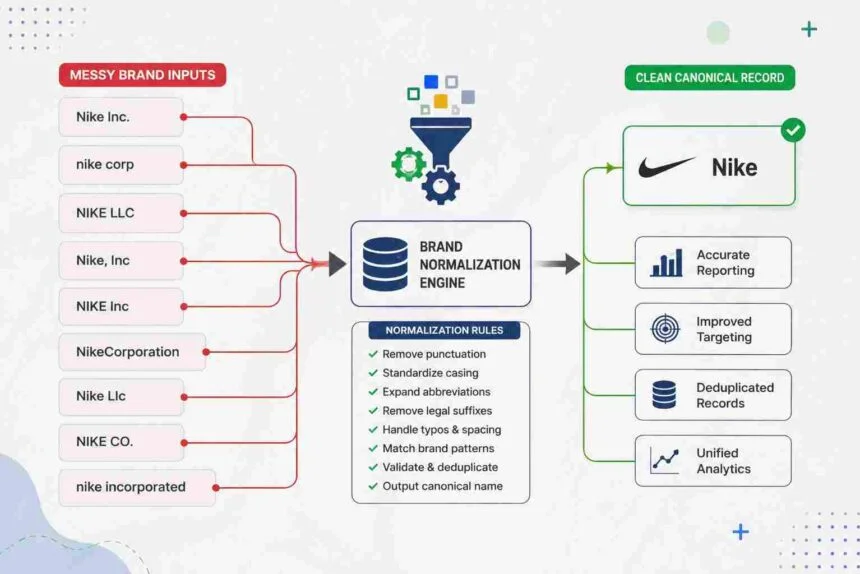
Brand name normalization rules are a defined set of transformations that standardize how company names appear across databases, CRM systems, and marketing platforms. Every rule converts inconsistent inputs into one approved version — the canonical name — so that “Nike,” “NIKE Inc.,” and “nike®” all resolve to the same record. Most teams discover this problem only after their reports start lying to them.
- Brand Name Normalization Rules — What They Actually Do to Your Data
- Five Entry Points That Are Silently Corrupting Your Brand Data Right Now
- The 8-Rule Sequence That Turns Messy Brand Data Into One Clean Record
- How to Set Up a Normalization System That Cleans Brand Data Before It Even Hits Your CRM
- Why Your Exact Rules Will Miss 18% of Duplicates — and What Fills the Gap
- The Four Normalization Errors That Create More Duplicates Than They Fix
- The 80/20 Split: Which Normalization Tasks Machines Handle Better Than Humans
- How to Know Your Normalization Rules Are Actually Working — the Metrics That Matter
- How Brand Name Normalization Works Differently in E-Commerce, SEO, and Enterprise Data
- How AI Is About to Change Brand Name Normalization — and What Your Ruleset Still Needs to Do
- Conclusion
- Frequently Asked Questions
Brand Name Normalization Rules — What They Actually Do to Your Data
At its core, normalization rules solve a matching problem. Systems don’t read brand names the way humans do. A database has no idea that “Salesforce Corp” and “Salesforce, Inc.” are the same company — it treats them as two separate entities, splits revenue across both, and quietly breaks every downstream report that depends on account-level data.
The corrective framework works by running raw data through a sequence of transformations before it ever reaches your CRM. Each transformation strips one layer of variation. The output is a single, authoritative representation that every system in your stack can agree on.
This matters more than most teams realize. Bad CRM data costs B2B organizations an estimated 20–30% of their sales and marketing budget through duplicate outreach, fractured attribution, and inaccurate segmentation — not a rounding error, a budget line item disappearing silently.
Five Entry Points That Are Silently Corrupting Your Brand Data Right Now
Inconsistency doesn’t come from one place. It accumulates from every direction simultaneously.
Web forms let users type whatever they want. One rep enters “Google LLC,” another types “Google,” a third copies from a business card and writes “Google US.” CSV imports from vendors arrive with their own conventions, often built around a completely different system’s naming logic. Manual entry by a sales team under quota pressure produces shortcuts, abbreviations, and typos that harden into permanent records.
Third-party enrichment tools add a layer that’s easy to overlook. Clearbit, LinkedIn, and similar platforms pull canonical names from their own reference databases — which don’t always match each other. When two enrichment sources disagree and both write to the same field, one of them overwrites the other, and neither system flags it.
Mergers and acquisitions create a structural version of the same problem. When two companies combine their CRM databases, both brand name histories come with them. Without explicit normalization rules applied at the point of integration, both naming conventions persist indefinitely.
The single most effective change is moving normalization upstream — to the point of ingestion — rather than treating it as a periodic cleanup task.
The 8-Rule Sequence That Turns Messy Brand Data Into One Clean Record
Apply these rules in order. Each transformation depends on the clean state created by the one before it. Running them out of sequence introduces new inconsistencies while fixing old ones.
| Rule | Transformation | Example |
| 1 | Strip legal entity suffixes | “Salesforce, Inc.” → “Salesforce” |
| 2 | Standardize capitalization | “JOHNSON & JOHNSON” → “Johnson & Johnson” |
| 3 | Normalize punctuation & special characters | “A.B.C. Corp.” → “ABC” |
| 4 | Standardize abbreviations | “Intl” → “International” (or vice versa — pick one) |
| 5 | Separate operational names from legal names | Keep “HubSpot” in CRM; “HubSpot LLC” in contracts |
| 6 | Handle parent/subsidiary relationships | “Instagram” linked to “Meta” or normalized to it |
| 7 | Manage geographic and regional variants | “Google Ireland Limited” → “Google” (or kept, by context) |
| 8 | Remove leading “The” | “The Home Depot” → “Home Depot” |
Rule 1 — Strip Legal Entity Suffixes: Suffixes like Inc., LLC, Corp., Ltd., GmbH, AG, PLC, SARL, BV, and Pty Ltd serve compliance purposes. For data matching, they provide zero signal. “Deutsche Bank AG” and “Deutsche Bank” are identical entities — your system shouldn’t disagree. Build a comprehensive suffix list for every country your data covers, then maintain a strict exception list for brands where the suffix is the actual name (the retailer “The Limited” is not “The”).
Rule 2 — Standardize Capitalization: Unconfigured systems treat “netflix” and “Netflix” as separate records. Enforce Title Case as the global default. Two exceptions apply: preserve intentional lowercase branding (adidas, eBay, iPhone) and keep acronyms under four letters fully uppercase (IBM, BMW, IKEA). Build these into a canonical exceptions list that bypasses the default rule.
Rule 3 — Normalize Punctuation and Special Characters: Periods in abbreviations, commas before suffixes, registered trademark symbols — all of it creates string variants your system can’t match. “McDonald’s” keeps its apostrophe because that’s the actual brand. “H&M” stays “H&M.” What gets stripped: periods in “A.B.C. Corp.,” leading and trailing spaces, multiple internal spaces from CSV imports, and quotation marks that wrap company names in export files.
Rule 4 — Standardize Abbreviations: The challenge here is knowing which abbreviations to expand and which to preserve. IBM doesn’t become “International Business Machines.” AT&T stays AT&T. 3M stays 3M. But “Mfg” becoming “Manufacturing” and “Intl” resolving consistently are worth enforcing. The rule is: build your canonical list based on how these companies are actually referenced in your industry, then stick to it.
Rule 5 — Separate Operational Names From Legal Names: Your CRM should carry the name your team uses day-to-day. Your contracts field carries the legal entity name. Conflating these creates problems in both directions — overly formal strings appearing in marketing campaigns, and informal nicknames showing up in compliance documents. Maintain separate fields and normalize each one independently.
Rule 6 — Handle Parent and Subsidiary Relationships: There’s no universal answer here. A company selling enterprise software might normalize “Instagram” to “Meta” because it engages at the corporate level. An agency running Instagram campaigns needs those records separate. The decision depends on how your business actually engages with these entities — document it explicitly in your normalization playbook.
Rule 7 — Manage Geographic and Regional Variants: “Google LLC,” “Google UK Limited,” and “Google Ireland Limited” are legally distinct but often the same entity for sales purposes. Strip geographic qualifiers when you’re tracking at the brand level. Preserve them when territory assignment, compliance requirements, or separate contracts make the distinction meaningful.
Rule 8 — Remove Leading “The”: Drop it by default. “The Home Depot” becomes “Home Depot.” “The New York Times” is a judgment call — “New York Times” sounds incomplete to most readers, so this one stays. Flag edge cases like this in your exception list rather than applying the rule blindly.
The practical test: run six known variants of the same company name through your rule sequence and confirm they all resolve to one canonical output. If any don’t, the rule order or exception handling needs adjustment.
How to Set Up a Normalization System That Cleans Brand Data Before It Even Hits Your CRM
Building rules is the easy part. Operationalizing them is where most teams stall.
Step 1 — Audit Your Current Brand Data: Export all unique company name values from every system where brand information lives — sales, marketing, finance, procurement, e-commerce. Count distinct variants per brand. A global brand like Nike showing up in five formats across one database isn’t unusual; it’s the baseline. This audit quantifies the problem and makes the case for investment.
Step 2 — Create a Master Brand List: For every significant brand in your database, designate one canonical form. Every variation maps to it.
| Raw Variation | Canonical Form |
| Microsoft Corporation | Microsoft |
| MSFT | Microsoft |
| Microsoft Corp. | Microsoft |
| Alphabet Inc. | Alphabet |
| Google LLC |
Validate this list with legal, branding, and compliance stakeholders before publishing it. Conflicts caught here are far cheaper than conflicts caught in a board-level report.
Step 3 — Build a Variation Mapping Table: The mapping table is the translation layer between raw inputs and canonical outputs. Test it carefully. “ABC Electronics” and “ABC Clothing” share a prefix but are completely different companies. Over-normalization — merging brands that shouldn’t merge — produces reporting errors that can take months to trace back to the source. When in doubt, require an additional signal (domain, location, industry) before confirming a match.
[INTERNAL LINK: CRM data hygiene best practices]
Step 4 — Integrate Rules at the Point of Ingestion: Normalization applied at ingestion means dirty data never enters the system. Normalization applied retroactively means you’re constantly fighting the same problem. Embed transformation logic into data pipelines, form submission handlers, and integration layers from third-party tools. When a sales rep types “Amazon” into a free-text field, the system should standardize it before the record saves.
Step 5 — Document Rules in a Normalization Playbook: The playbook makes the system durable. Document: canonical name decisions, exception lists for brands with non-standard styling, the order transformations run, and rules for edge cases like numbers in names and non-Latin characters. Update it immediately when a major brand rebrands — Twitter becoming X is the obvious example of what happens when playbooks lag behind reality.
Why Your Exact Rules Will Miss 18% of Duplicates — and What Fills the Gap
Exact string matching catches perfect variations. It won’t catch “Nke” for “Nike” or “Mircrosoft” for “Microsoft.” Fuzzy matching closes that gap by identifying near-duplicates that differ by a typo, a suffix, or a transposition.
One mid-market SaaS company tracked 18% of its CRM companies as duplicates, traced entirely to naming inconsistencies. After applying normalization rules combined with fuzzy matching, duplicates dropped 92%, revenue reporting accuracy improved 35%, and sales reps recovered roughly four hours per week previously spent reconciling records.
Tools like Insycle, Openprise, and DemandTools handle this at scale for HubSpot and Salesforce environments. The key configuration decision is the confidence threshold — how similar two strings need to be before the system flags them as a potential match. Set it too low and you get false positives (separate companies merged incorrectly). Set it too high and duplicates slip through.
The right workflow: run deterministic rules first. Let fuzzy logic catch what slips through. Flag potential matches with low confidence scores for human review rather than auto-merging.
The Four Normalization Errors That Create More Duplicates Than They Fix
Over-aggressive matching is the most consequential mistake. “ABC Company” and “ABC Corp” might be the same entity — or they might be two completely different businesses. Automated merging at low confidence thresholds combines records that should stay separate, and the resulting distortion in revenue reporting can take months to surface.
Destroying meaningful information is the second. Geographic qualifiers, DBA names, and subsidiary names look like noise but often carry real operational meaning. Which entity you’re contracted with, how a customer identifies itself for billing — stripping this before preserving it elsewhere creates problems in legal and finance contexts. Always save the original value in a separate field before normalizing the display field.
Ignoring data source quality compounds both. Data from a verified enrichment source like Clearbit or LinkedIn is more reliable than a free-text web form entry. Without source-priority rules, a verified canonical name can get overwritten by a sales rep’s shorthand. Implement a trust hierarchy: enriched data doesn’t get overwritten by manual entry unless a human explicitly approves it.
One-time cleanup thinking is the slowest failure mode. Normalizing your database once and declaring it done means you’ll be back at the same problem within months. New data enters constantly. The only fix that holds is normalization baked into every inbound record — not a quarterly event.
The 80/20 Split: Which Normalization Tasks Machines Handle Better Than Humans
Not every normalization decision can or should be automated. The split that actually works in practice:
Automate:
- Suffix removal — clear rules, low risk of error
- Casing standardization — deterministic transformation
- Whitespace and punctuation cleanup — no judgment required
- Known brand exceptions lookup — matching against your canonical list
Route to human review:
- Potential duplicate matches with low confidence scores
- Parent/subsidiary relationship decisions
- High-value accounts where a merge error is costly
- Cases where multiple valid canonical forms exist
| Task | Method | Risk if Wrong |
| Strip “Inc.” | Automate | Very low |
| Title Case correction | Automate | Very low |
| “ABC Corp” vs “ABC Co” | Human review | Medium |
| Instagram → Meta | Human decision | High |
| Geographic variants | Human decision | High |
HubSpot Operations Hub covers basic normalization for teams already in that ecosystem. Insycle and Openprise provide more sophisticated rules engines for complex environments. RingLead and Databar add enrichment-layer normalization, standardizing names as part of broader data workflows. For smaller operations, Google Sheets with REGEX formulas handles core transformations without a paid tool.
The goal isn’t 100% automation. Automating the 80% that’s mechanical gives humans capacity to handle the 20% that requires actual judgment.
How to Know Your Normalization Rules Are Actually Working — the Metrics That Matter
Governance without measurement is guesswork. Assign ownership of normalization rules to a specific team — data governance, brand management, or a cross-functional committee — and build a formal change request process for updates when brands rebrand, merge, or get acquired.
Track these metrics before and after implementation:
| Metric | Typical Before | After Normalization |
| CRM duplicate record rate | ~30% average | ~9% (PayFit case study) |
| Inbound lead matching accuracy | Baseline failures | 30–50% improvement |
| PIM attribute accuracy | Inconsistent | 99.9% precision rate |
| Revenue leakage from bad data | 12–15% inefficiency | 1–2% direct marketing ROI lift |
Run quarterly audits to catch new variations that entered the system since the last review. Trigger immediate updates when a major brand changes its name — not at the next scheduled review. If analysts are spending less time correcting brand records and more time running analysis, the system is working.
How Brand Name Normalization Works Differently in E-Commerce, SEO, and Enterprise Data
The rules are consistent. How they apply — and what’s at stake when they fail — varies by context.
In e-commerce, inconsistent brand names cause the same product to appear under multiple listings, fragmenting search results and confusing customers who can’t find what they’re looking for. A unified brand name across product catalog and category taxonomy directly affects discoverability and conversion.
In marketing and advertising, normalized brand names make campaign attribution work. When a brand appears in five formats across campaign data, you can’t accurately measure ROI by account. Clean names mean clean performance data.
The SEO angle is where competitors consistently underdeliver. Search engines use brand entity signals to understand a brand’s identity across the web. Inconsistent naming across your website, structured data, product listings, and third-party mentions weakens that signal. Google’s Knowledge Graph relies on consistent entity representations to build confident associations between a brand name and its real-world entity. Normalization isn’t just a CRM problem — it’s a direct input to how authoritatively your brand appears in knowledge panels and structured search results.
In enterprise data and PIM systems, normalization operates differently from CRM because the stakes include product attribute accuracy, regulatory reporting, and supply chain data — not just sales reporting. The 99.9% precision rate cited for PIM normalization reflects how little tolerance these systems have for variation.
How AI Is About to Change Brand Name Normalization — and What Your Ruleset Still Needs to Do
AI is genuinely improving the hardest parts of this problem. Machine learning models can now detect mergers and acquisitions, infer canonical names from contextual signals like domain data and website content, and flag new brand variants before they accumulate into a pattern. By 2026, AI-assisted normalization can handle roughly 90% of edge cases that previously required manual review.
What that doesn’t change: AI learns from your rules. A model trained on messy, unnormalized data learns the mess. The documented normalization playbook — the canonical list, the exception list, the source hierarchy — remains the foundation that makes AI-assisted normalization accurate rather than just fast.
The practical shift is from manual governance to supervised automation. Teams that previously spent hours on quarterly cleanups will increasingly spend that time reviewing AI-flagged edge cases and updating the canonical list. The judgment requirement doesn’t disappear; it concentrates.
Conclusion
Brand name normalization rules are data infrastructure. Nobody gets excited about infrastructure until something breaks — and when inconsistent brand naming breaks things, the cost shows up in campaign waste, executive dashboards with three different revenue figures for the same client, and sales teams unknowingly working the same account from different records.
The path forward is straightforward: define canonical names, build transformation rules in sequence, integrate them at ingestion, document exceptions, and review quarterly. Pair deterministic rules with fuzzy matching for the gaps. Automate the mechanical 80%. Keep humans in the loop for the decisions that matter.
The teams that treat this as a one-time cleanup project keep fighting the same problem. The ones that build it into their data pipeline stop fighting it entirely.
Frequently Asked Questions
What is the difference between brand name normalization and deduplication?
These are two distinct operations that work together. Normalization standardizes the format of a brand name — fixing capitalization, stripping suffixes, resolving abbreviations. Deduplication removes redundant records after that standardization runs. Run normalization first: deduplication accuracy depends directly on having clean, consistent names to compare.
Should I use a brand’s official stylization or apply my own standard?
For well-documented brands — adidas, eBay, iPhone — use the official stylization. Applying Title Case to “eBay” produces “Ebay,” which is incorrect and undermines the trust of anyone who spots it. For lesser-known brands without documented style requirements, Title Case is the safe default. The goal is matching how customers recognize and search for the brand.
How often should brand name normalization rules be reviewed?
Quarterly reviews work for most organizations as a baseline. Immediate updates are required when a brand rebrands, merges, or gets acquired — any event that changes the canonical name in the market. Twitter becoming X is the example every normalization guide cites, but it happens across dozens of companies every quarter at smaller scale.
What tools handle brand name normalization at scale?
Insycle and Openprise are the most widely cited for HubSpot and Salesforce environments. DemandTools works well for Salesforce-heavy teams. RingLead and Databar add normalization as part of broader enrichment workflows. For smaller operations without a dedicated data tool budget, Google Sheets with REGEX formulas covers the core transformations effectively.
What happens when two brands have similar or identical names?
This is where normalization requires human oversight rather than automation. “ABC Electronics” and “ABC Clothing” share a prefix but are completely separate companies. Flag similar-name cases for review and require additional confirming signals — domain, industry, location — before merging records. Auto-merging on name similarity alone creates reporting errors that are genuinely hard to untangle.
How do I handle a company that has rebranded or been acquired?
Build a mapping from old names to new names in your canonical list. If your organization has standardized on “Meta,” then “Facebook” should map to it — including in historical records where the old name still appears. Keep the old canonical name in a separate alias field so legacy references still resolve correctly.
Should normalization happen in real-time or as a batch process?
Both, for different reasons. Real-time normalization at ingestion prevents dirty data from entering your system in the first place. Periodic batch processes catch records that slipped through or apply updated rules to historical data after the playbook changes. Neither alone is sufficient.
Does inconsistent brand naming actually affect SEO?
Directly. Search engines build entity associations from signals across your website, structured data, product listings, and third-party mentions. When these sources use different brand name formats, the entity signal weakens. Consistent naming strengthens your brand’s presence in knowledge panels, improves how structured data is interpreted, and contributes to the topical authority signals that influence ranking.