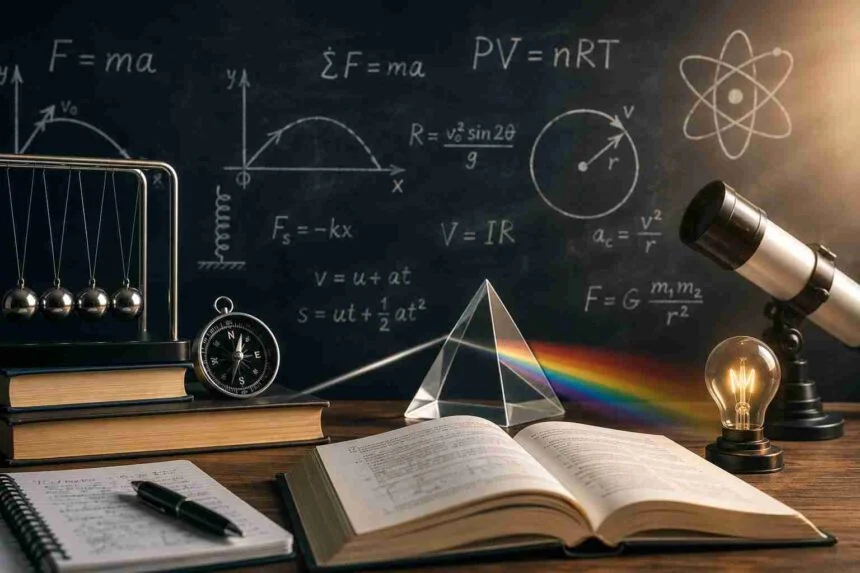
Physics fundamentals are the core laws and principles that explain how the universe behaves — from how objects move to how energy transforms. These principles form the foundation of every science and engineering discipline. Whether you’re a high school student or just starting to explore the subject, understanding physics fundamentals gives you a framework for explaining almost everything in the natural world.
- What Are Physics Fundamentals?
- The Five Core Laws That Govern the Universe
- Newton’s Laws of Motion
- Law of Universal Gravitation
- Conservation of Energy
- Laws of Thermodynamics
- Electromagnetic Theory
- Classical Mechanics — Motion, Forces, and Momentum
- Waves and Optics
- Thermodynamics and Energy
- Electromagnetism and Circuits
- Modern Physics
- Physics Fundamentals in Daily Life
- How to Learn Physics Fundamentals Effectively
- Conclusion
- FAQs
- What are the fundamentals of physics?
- What are the five laws of physics?
- Why is physics important in daily life?
- What is the best way to learn physics fundamentals?
- What is the difference between classical mechanics and modern physics?
- What topics are covered under physics fundamentals?
- How is physics different from chemistry?
- What math skills are needed to understand physics fundamentals?
What Are Physics Fundamentals?
Physics is the study of matter, energy, force, and time — and how they interact. Physics fundamentals are the specific laws and concepts that describe these interactions at every scale, from subatomic particles to galaxies.
The subject breaks into several major branches:
- Classical Mechanics — motion, forces, and momentum
- Thermodynamics — heat, energy, and entropy
- Electromagnetism — electric and magnetic fields
- Waves & Optics — light, sound, and wave behavior
- Modern Physics — quantum mechanics and relativity
Each branch has its own laws, but they’re all connected. Mastering these fundamentals gives you the tools to understand both the physical world and the technology built on top of it.
The Five Core Laws That Govern the Universe
Across all of physics, five laws stand out as the most foundational. Every other principle builds on them.
Newton’s Laws of Motion
Newton’s three laws define how objects move and respond to forces. The first law establishes inertia — an object stays at rest or in motion unless acted on by a net force. The second law quantifies this: F = ma, meaning force equals mass times acceleration. The third law states that every action produces an equal and opposite reaction.
These laws predict everything from projectile trajectories to satellite orbits to the forces in engineered structures like bridges.
Law of Universal Gravitation
Also proposed by Isaac Newton, this law states that any two masses attract each other with a gravitational force proportional to their masses and inversely proportional to the square of the distance between them. It explains why the Moon orbits Earth and why objects fall at the same rate regardless of mass.
Conservation of Energy
Energy cannot be created or destroyed — it only changes form. Kinetic energy becomes potential energy at the top of a ramp. Thermal energy drives engines. Electrical energy powers circuits. This law underlies everything from renewable energy systems to the way your body metabolizes food.
Laws of Thermodynamics
These laws govern how energy moves and transforms. The first law is conservation of energy applied to heat and work. The second law introduces entropy — natural processes move toward disorder. Together, they explain how engines, refrigerators, and heat transfer systems work.
Electromagnetic Theory
This covers how electric charges interact and how electric and magnetic fields propagate through space. Electromagnetic induction, Coulomb’s law, and Ohm’s law all fall under this framework. It forms the theoretical backbone of modern electronics.
Classical Mechanics — Motion, Forces, and Momentum
Classical mechanics is usually the starting point in any physics course, and for good reason. It covers the most observable, everyday phenomena.
Kinematics
Kinematics describes motion without asking what caused it. The SUVAT equations linking displacement, initial velocity, final velocity, acceleration, and time — are the practical toolkit here. Mastering these equations lets you solve problems involving uniform motion, accelerated motion, and falling objects.
A practical tip: sketch a motion diagram before applying any SUVAT equation. Students who visualize the problem first consistently set up equations more accurately.
[INTERNAL LINK: SUVAT Equations — complete guide with worked examples]
Forces and Newton’s Laws in Practice
Once you add forces into the picture, you move from describing motion to explaining it. Key forces include friction, gravitational forces, centripetal forces, tension, and normal force. F = ma connects them all — knowing any two variables lets you solve for the third.
In circular motion, centripetal force always points toward the center of the circle. This is a common exam mistake: students often treat centripetal force as a separate force rather than the net inward force produced by gravity, tension, or friction.
Momentum and Collisions
Momentum (mass × velocity) is conserved in every collision when no external forces act. Elastic collisions conserve both momentum and kinetic energy. Inelastic collisions conserve only momentum.
| Collision Type | Momentum Conserved | Kinetic Energy Conserved |
| Elastic | Yes | Yes |
| Inelastic | Yes | No |
| Perfectly Inelastic | Yes | No (objects stick together) |
Understanding the centre of mass helps predict how systems move as a whole, especially in multi-body problems.
Waves and Optics
Wave physics explains how energy propagates through a medium — or in some cases, through a vacuum.
Transverse waves oscillate perpendicular to their direction of travel. All electromagnetic radiation — radio waves, visible light, X-rays — are transverse waves. Longitudinal waves, like sound, oscillate parallel to the direction of travel.
The wave equation v = fλ connects speed, frequency, and wavelength for every wave type. The Doppler effect describes how observed frequency changes when a source or observer moves — it’s why a siren sounds higher-pitched as it approaches and lower as it passes.
Other key phenomena include reflection, refraction, interference, and polarization. Young’s double-slit experiment remains one of the most important demonstrations in all of physics — it proved that light behaves as a wave. [INTERNAL LINK: Young’s Double-Slit Experiment — explained with diagrams]
Thermodynamics and Energy
Energy is the central concept across all of physics. Thermodynamics specifically deals with how energy transfers and transforms through heat and work.
The first law of thermodynamics is conservation of energy applied to thermodynamic systems. The second law introduces entropy — systems naturally move from order to disorder unless energy is added.
The ideal gas law (PV = nRT) connects pressure, volume, temperature, and the amount of gas. It’s derived from the kinetic theory of gases, which models gas molecules as constantly moving particles whose average kinetic energy determines temperature.
Heat transfers through three mechanisms: conduction (direct contact), convection (fluid movement), and radiation (electromagnetic waves). Specific heat capacity tells you how much energy a material needs to change temperature — a critical concept in both engineering and environmental science.
Electromagnetism and Circuits
Electric charge and its behavior underpin all of modern electronics. Coulomb’s law quantifies the force between two charges — attractive for opposite charges, repulsive for like charges. Electric fields describe the force a charge would experience at any point in space.
In circuits, Ohm’s law (V = IR) relates voltage, current, and resistance. Conductors allow charge to flow freely; insulators resist it. Static electricity builds up when charge transfers through induction or conduction.
Electromagnetic induction — the generation of current through a changing magnetic field — is how generators and transformers work. Every time you charge your phone or use Wi-Fi, electromagnetic principles are doing the work.
[INTERNAL LINK: Ohm’s Law — V = IR explained with circuit examples]
Modern Physics
Classical mechanics breaks down at very high speeds and very small scales. That’s where modern physics takes over.
Special relativity, developed by Albert Einstein, established that the speed of light is constant for all observers and that mass and energy are equivalent (E = mc²). At subatomic scales, quantum mechanics replaces Newtonian certainty with probability. Wave-particle duality shows that particles like electrons behave as both waves and particles depending on how you measure them.
The photoelectric effect — which Einstein explained using photons — helped establish quantum theory. The Heisenberg Uncertainty Principle states that you cannot simultaneously know a particle’s exact position and momentum.
At the largest scales, particle physics explores the fundamental building blocks of matter. CERN’s experiments with the Large Hadron Collider confirmed the existence of the Higgs boson in 2012 — a major milestone in understanding how particles acquire mass. Research into dark matter and dark energy continues to challenge current models.
Physics Fundamentals in Daily Life
Physics isn’t abstract — it shows up constantly in ordinary situations.
Smartphones rely on electromagnetism to transmit signals, process data, and connect to Wi-Fi. The touchscreen, camera sensor, and antenna all depend on electromagnetic principles. Car safety features like airbags and crumple zones apply conservation of momentum — by extending the time of a collision, they reduce the peak force on passengers. Bridges and buildings are engineered using Newton’s laws and material stress analysis. Renewable energy systems — solar panels, wind turbines — depend on electromagnetic induction and thermodynamic efficiency principles.
Understanding these connections makes physics practical, not just academic.
How to Learn Physics Fundamentals Effectively
The biggest mistake students make is memorizing equations before understanding the physical intuition behind them. Always start with the concept — what is actually happening physically — before reaching for a formula.
A practical approach that works:
- Understand the concept first — What does this law say about the physical world?
- Study worked examples — See how equations are applied step by step
- Attempt problems independently — Start simple, increase complexity
- Use simulations and virtual labs — These build spatial and quantitative intuition faster than static diagrams
- Review formula sheets as references, not shortcuts — Know what each variable means
Short, consistent daily study sessions outperform occasional cramming. Physics is cumulative — each topic builds on previous ones, so gaps compound quickly. Hands-on experiments, even simple ones like a pendulum observing harmonic motion, connect abstract equations to real behavior.
Conclusion
Physics fundamentals — spanning motion, energy, forces, conservation laws, electromagnetism, waves, and modern physics — provide the framework for understanding the natural world at every scale. These aren’t just academic concepts. They explain the technology around you, the forces acting on every structure, and the behavior of matter from the subatomic to the cosmic. Building a solid foundation in these principles sharpens critical thinking and problem-solving skills that extend well beyond physics itself.
FAQs
What are the fundamentals of physics?
Physics fundamentals are the core laws governing how the universe behaves — classical mechanics (motion, forces, momentum), thermodynamics (heat and entropy), electromagnetism (electric and magnetic fields), waves and optics (light and sound), and modern physics (quantum mechanics and relativity). These branches form the foundation of all scientific and engineering study.
What are the five laws of physics?
The five most foundational laws are Newton’s Laws of Motion, the Law of Universal Gravitation, Conservation of Energy, the Laws of Thermodynamics, and Electromagnetic Theory. Every major branch of physics builds on at least one of these.
Why is physics important in daily life?
Physics explains the technology and safety systems people use every day. Smartphones depend on electromagnetic principles. Car airbags and crumple zones apply conservation of momentum. Buildings and bridges rely on Newton’s laws. Engines and refrigerators operate according to the laws of thermodynamics.
What is the best way to learn physics fundamentals?
Start with physical intuition before memorizing equations. Study worked examples, attempt problems independently, and use interactive simulations to build visual understanding. Consistent short study sessions are more effective than cramming, because physics topics build on each other cumulatively.
What is the difference between classical mechanics and modern physics?
Classical mechanics — built on Newton’s laws — accurately describes the motion of everyday macroscopic objects. Modern physics, which includes quantum mechanics and special relativity, addresses behavior at subatomic scales and near the speed of light, where classical rules break down.
What topics are covered under physics fundamentals?
Core topics include kinematics, forces, momentum, energy, thermodynamics, waves, optics, electricity, magnetism, circuits, rotational dynamics, fluid mechanics, nuclear physics, and radioactive decay. Advanced study adds quantum mechanics, special relativity, and particle physics.
How is physics different from chemistry?
Physics studies matter, energy, and the fundamental laws governing their interactions at every scale. Chemistry focuses specifically on the properties of atoms, molecules, and chemical reactions. Physics provides the underlying principles — like electromagnetic force — that explain why chemical bonds form and how reactions release energy.
What math skills are needed to understand physics fundamentals?
A solid grasp of algebra is essential for most introductory topics. You’ll also need to work with scientific notation, metric conversions, and vector quantities. SUVAT equations require basic algebraic manipulation. More advanced topics like electromagnetism and quantum mechanics draw on calculus, but many core concepts are accessible without it.