Introduction
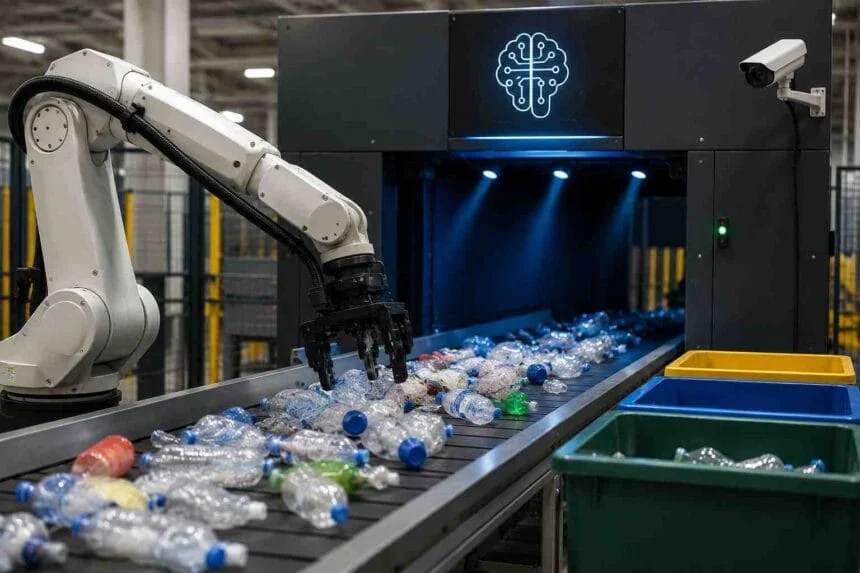
MataRecycler is an intelligent recycling system that uses artificial intelligence, IoT sensors, and machine learning to sort, track, and manage waste more accurately than traditional methods allow. It operates as a connected platform, not just a single device, linking smart bins, cloud analytics, and user-facing apps into one coordinated waste management system.
- Introduction
- What Is MataRecycler and How Does It Work
- The Global Waste Crisis MataRecycler Aims to Solve
- Global waste challenges and statistics
- Limitations of traditional recycling systems
- Overflowing landfills and environmental pressure
- Key Features of the MataRecycler Platform
- Automated waste recognition and sorting accuracy
- Smart collection and route optimization
- Mobile app and user dashboard
- Core Technologies Powering MataRecycler
- Artificial intelligence in waste sorting
- Machine learning for continuous improvement
- IoT integration and real-time tracking
- Environmental Benefits of Using MataRecycler
- How MataRecycler Benefits Businesses and Cities
- MataRecycler’s Role in Smart Cities
- MataRecycler vs Traditional Recycling Systems
- Challenges and Future Potential of MataRecycler
- Implementation challenges
- Scalability and global adoption potential
- Future developments and innovation
- Conclusion
- Frequently Asked Questions
- What is MataRecycler and what does it do?
- How does MataRecycler reduce recycling contamination?
- What makes MataRecycler different from traditional bins?
- Can businesses use MataRecycler for waste management?
- Is MataRecycler useful for cities?
- Does MataRecycler support circular economy goals?
- How does MataRecycler help reduce landfill waste?
- What is the future potential of MataRecycler technology?
The global recycling problem is not a motivation problem. According to The Recycling Partnership, 94% of Americans believe recycling matters. The real failure is infrastructural: contamination rates in curbside programs run between 17% and 25%, meaning one in five loads gets rejected and sent to landfill anyway. MataRecycler addresses that specific breakdown, not recycling behavior in general.
It is designed for households, businesses, and cities but its strongest value shows at scale, where sorting errors and collection inefficiencies compound into serious operational and environmental costs.
What Is MataRecycler and How Does It Work
MataRecycler functions as a smart waste management platform built around automated material identification. When waste enters the system through a smart bin or a guided app interaction the platform classifies the material, records the action, and routes that data to a central processing layer. The result is a continuous identify-sort-track-improve loop that gets more accurate with use.
Core technology and system overview
Three technologies run the system together: artificial intelligence for classification, machine learning for ongoing refinement, and cloud-based analytics for operational insight. AI handles real-time material identification across categories including plastics, metals, paper, glass, and electronic waste. Machine learning means the system doesn’t plateau; it keeps adjusting as new packaging types, contamination patterns, and regional sorting rules evolve.
What distinguishes this from earlier smart bin concepts is the cloud layer. Collected data doesn’t just log, it feeds sustainability dashboards that operations managers and city planners can actually use for decision-making.
Role of smart bins and IoT sensors
MataRecycler IoT bins do more than hold waste. Embedded fill-level sensors track capacity in real time, sending alerts before overflow occurs. This matters operationally: unnecessary collection runs account for a significant share of municipal fleet fuel costs, and dynamic routing based on actual fill data can reduce truck frequency by 30% to 50%, according to a December 2025 industry report by SmartEnds.
Connected devices across a deployment zone create a waste tracking system with genuine spatial awareness — something no manual program can replicate at the city scale.
Data flow and cloud analytics
Once sensor data reaches the cloud, the platform converts it into structured operational reports and sustainability dashboards. Patterns become visible: which locations contaminate most, which routes run inefficiently, which material categories are underperforming. That transparency supports digital transformation in waste operations replacing guesswork with measurable, comparable data.
The Global Waste Crisis MataRecycler Aims to Solve
Global waste challenges and statistics
The World Bank recorded 2.56 billion tonnes of waste generated globally in 2022 a figure the 2018 projections hadn’t expected until 2030. Under a business-as-usual path, that number could reach 3.86 billion tonnes by 2050. UNEP frames the same data as both a cost crisis and a climate one: direct waste management costs were already enormous in 2020, and indirect costs from pollution, health impacts, and lost materials make the true burden significantly heavier.
Population growth alone doesn’t explain the acceleration. Rising consumption rates and outdated collection infrastructure in developing regions are the stronger drivers.
Limitations of traditional recycling systems
Manual sorting introduces errors at every stage. Workers on busy facility shifts typically reach 85% to 90% accuracy and that rate drops as volume increases. Curbside guidance remains inconsistent across municipalities, leaving households genuinely unsure what belongs in which bin.
The result is contamination. When greasy containers, plastic bags, or non-recyclables enter the recycling stream, entire loads get rejected. The EPA has consistently noted that recycling requires more than collection; it requires correct sorting, which traditional infrastructure often cannot guarantee.
Overflowing landfills and environmental pressure
Landfills don’t passively store waste. They produce methane, a greenhouse gas that accounts for approximately 14.3% of total domestic methane emissions in the United States. Landfill tipping fees have climbed 3% to 4% annually over the past decade, creating compounding financial pressure on municipalities. Recycling and composting, by contrast, averted roughly 186 million metric tonnes of CO₂ equivalent emissions in 2018 alone. The economic and environmental case for better systems is not theoretical.
Key Features of the MataRecycler Platform
Automated waste recognition and sorting accuracy
The platform’s core differentiator is sorting precision. AI-powered waste sorting achieves over 95% accuracy — in some configurations, reaching 98%. Compared to human sorters at 85% to 90% on a good shift, that gap compounds at scale across millions of items. The system identifies plastics, metals, paper, glass, and electronic waste based on shape, density, and composition — without fatigue, and without slowdown during high-volume periods.
Critically, it also reduces false classifications. When recyclable materials get rejected due to misidentification, they go to the landfill regardless of actual contamination. Improved sorting precision directly raises material recovery rates.
Smart collection and route optimization
Predictive waste collection routing changes how municipalities plan fleet operations. Instead of fixed schedules that regularly send trucks to half-empty bins, the system dispatches based on real fill-level data. That means:
- Fewer unnecessary collection trips
- Lower fuel consumption per tonne collected
- Reduced vehicle emissions across the fleet
- More efficient labor allocation
Businesses report landfill expense reductions of 40% to 60% after adopting smart collection systems. For tight municipal budgets, that’s a structural improvement, not just an efficiency gain.
Mobile app and user dashboard
The MataRecycler app serves as the user-facing layer. It provides disposal guidance, tracks individual recycling activity, and can support rewards or engagement programs. The user dashboard makes recycling visible and measurable which matters because invisible effort tends to drop off over time.
For businesses, the same dashboard supports ESG reporting by documenting waste output, diversion rates, and operational performance in formats that align with sustainability disclosure expectations.
Core Technologies Powering MataRecycler
Artificial intelligence in waste sorting
AI provides the classification engine. It processes visual and compositional data in real time to identify material types, even in mixed or ambiguous waste streams. The consistency is the main advantage — unlike human judgment, the system applies the same criteria at the 10,000th item as it did at the first.
In practice, the AI layer also supports sustainable recycling technology goals by ensuring that materials are correctly routed before errors compound downstream.
Machine learning for continuous improvement
Most implementations overlook this: the system’s value increases over time, not just at deployment. Machine learning allows MataRecycler to adapt as material types change, new packaging formats, regional rule differences, and shifting consumer behavior — without requiring manual reprogramming. Recognition improves, false classifications decrease, and the system becomes better calibrated to its specific environment.
IoT integration and real-time tracking
The IoT layer connects bins, sensors, dashboards, and the app into one observable system. Real-time visibility means collection teams can react to problems before they escalate — an overflowing bin, a contamination spike, a route delay. Environmental monitoring systems and resource recovery systems benefit directly from this kind of operational awareness.
Environmental Benefits of Using MataRecycler
Better sorting means more materials stay usable. Every tonne of paper correctly recovered conserves approximately 17 trees and 7,000 gallons of water. Recycling aluminium uses 95% less energy than producing it from raw ore. These aren’t marginal gains — at the volumes modern communities generate, they represent meaningful reductions in resource extraction pressure.
Reducing landfill waste and contamination
Waste contamination reduction is where the environmental impact is most direct. When recyclable material is sorted correctly, it reaches facilities in usable condition rather than being rejected. Less rejection means less material routed to incinerators or landfills both of which carry their own emissions footprints.
The EPA links proper recycling directly to greenhouse gas reduction, natural resource conservation, and landfill diversion. MataRecycler’s automation targets the exact failure points that prevent those outcomes in conventional systems.
Contribution to circular economy goals
The Circular Economy model depends on materials re-entering production cycles rather than being discarded. MataRecycler supports that loop by improving the purity and volume of recovered materials — which makes them more viable for manufacturers to actually use. UNEP and the World Bank both frame waste management investment as inseparable from long-term circular economy progress.
How MataRecycler Benefits Businesses and Cities
Benefits for households
For households, the primary gain is clarity. Instead of guessing what belongs where, users receive real-time guidance and feedback. That reduces contamination mistakes which ultimately determines whether household recycling effort translates into actual material recovery.
Visible feedback also drives habit formation. When people can track their activity, participation stays more consistent than in programs that offer no confirmation that the effort had any effect.
Benefits for companies and industries
Companies managing waste across offices, factories, campuses, and retail spaces gain measurable operational control. Recyclable output tracking, contamination reduction, and cloud-based analytics together reduce disposal costs and support sustainability reporting. Digital transformation in waste operations also signals ESG commitment to investors and customers in a way that is increasingly expected rather than optional.
Cost efficiency and ESG compliance
ESG reporting requirements are tightening. Sustainability dashboards that document actual recycling performance by material type, volume, and diversion rate give compliance teams verifiable data rather than estimates. Beyond compliance, the cost efficiency gains from reduced landfill fees and smarter routes create a financial case that stands independently of environmental motivation.
MataRecycler’s Role in Smart Cities
Cities that implement connected infrastructure expect waste systems to match that standard. Fixed collection schedules, reactive problem-solving, and opaque performance data no longer align with how modern municipalities operate.
Supporting smart city development
MataRecycler fits smart city technology frameworks because it produces the kind of data cities already need: fill levels, route performance, recycling rates by district, and contamination hotspots. That information supports better public service delivery and makes recycling infrastructure a functional part of the urban data ecosystem rather than a separate, manually managed program.
MataRecycler and circular economy integration
At the city scale, circular economy integration means materials collected and processed locally can re-enter supply chains reducing dependence on virgin material imports. Zero-waste goals, which several major cities have formally adopted, require systems that can track material flows precisely enough to identify where diversion is failing. MataRecycler’s tracking layer makes that level of accountability practical.
MataRecycler vs Traditional Recycling Systems
| Feature | MataRecycler | Traditional Systems |
| Sorting method | AI-automated, 95%+ accuracy | Manual, 85–90% accuracy |
| Collection scheduling | Fill-level-based, dynamic | Fixed schedule, route-blind |
| Contamination detection | Real-time, pre-collection | Post-collection, reactive |
| User feedback | App-based, immediate | None or delayed |
| Data output | Live dashboards, ESG-ready reports | Manual logs, slow reporting |
| Scalability | Modular, city-wide deployment | Limited by workforce capacity |
Key differences in technology and efficiency
Visibility is the fundamental gap. Traditional systems cannot observe waste before collection they react after the fact. MataRecycler creates pre-collection intelligence: knowing what is in a bin, how full it is, and whether a pickup is actually needed. That shifts waste management from reactive to predictive.
Advantages of automation over manual systems
Automation doesn’t eliminate human involvement — it removes the repetitive, error-prone elements. Sorting workers, route planners, and facility managers can focus on higher-value decisions when automated systems handle classification and scheduling. Scalability improves because system capacity grows with hardware deployment, not headcount.
Challenges and Future Potential of MataRecycler
Implementation challenges
Deploying a connected recycling network requires upfront investment in smart sensors, app infrastructure, dashboards, and bin hardware. For smaller cities or organizations with limited capital, that initial cost creates a real barrier — even when long-term savings are clear. Coordination across departments adds friction. And technology alone doesn’t change behavior: user adoption requires sustained communication, clear design, and ongoing support to maintain accuracy gains over time.
Scalability and global adoption potential
The World Bank and UNEP both identify waste infrastructure investment as a priority response to the accelerating waste crisis. That policy alignment creates an opening for platforms like MataRecycler. If the system can be made adaptable enough for different regulatory environments and affordable enough for mid-size cities, not just well-funded metros, global adoption becomes genuinely achievable. Pilots already running in European and Asian cities are providing the proof-of-concept data that procurement decisions require.
Future developments and innovation
Enhanced material recognition is the most likely near-term development improving accuracy on mixed or degraded materials that current systems sometimes misclassify. Residential expansion and tighter smart city integration are also in progress, with bins that communicate directly with city management systems in real time. The direction is toward fully automated recycling ecosystems where collection, sorting, processing, and reporting operate as one continuous loop.
Conclusion
MataRecycler addresses a specific and measurable failure in recycling: the gap between materials that should be recovered and materials that actually are. By combining AI-powered sorting, IoT sensors, and cloud analytics into one platform, it reduces contamination, improves recycling accuracy, and gives households, businesses, and cities usable data to act on. The contamination problem that sends billions of tonnes of recyclable material to landfill each year is not unsolvable it is an infrastructure problem, and intelligent recycling systems are a direct answer to it. The question is no longer whether the technology works. It is how quickly it can be deployed at the scale the global waste crisis demands.
Frequently Asked Questions
What is MataRecycler and what does it do?
MataRecycler is a smart recycling platform that uses AI, IoT sensors, and data analytics to automatically sort, track, and manage waste. It connects smart bins, collection systems, and user apps into one coordinated platform that improves accuracy and reduces contamination across households, businesses, and cities.
How does MataRecycler reduce recycling contamination?
It uses real-time material detection to classify waste before collection, directing each item to the correct stream automatically. This removes the guesswork that causes contamination in manual systems, where misidentified materials get mixed and entire loads get rejected.
What makes MataRecycler different from traditional bins?
Traditional bins rely on users to sort correctly without feedback. MataRecycler bins use AI waste sorting and smart sensors to identify materials automatically, achieving over 95% accuracy compared to 85–90% for manual systems, and providing real-time data that traditional bins cannot generate.
Can businesses use MataRecycler for waste management?
Yes. Businesses use it for waste tracking, recyclable output reporting, ESG compliance, and operational efficiency. Cloud-based sustainability dashboards document performance by material type and diversion rate, which supports formal sustainability disclosures and reduces disposal costs.
Is MataRecycler useful for cities?
Cities use it to improve recycling infrastructure, optimize collection routes based on real fill-level data, and track recycling rates by district. It integrates with smart city technology frameworks, turning waste management into a data-driven municipal service rather than a fixed-schedule operation.
Does MataRecycler support circular economy goals?
It supports circular economy principles by improving the purity and volume of materials recovered for reuse. Higher-quality sorted output makes recovered materials more viable for manufacturers, helping close the loop between waste collection and production supply chains.
How does MataRecycler help reduce landfill waste?
By improving sorting accuracy to 95% or above, the system diverts materials that would otherwise be rejected due to contamination. Fewer rejections mean more material enters the recycling loop rather than being sent to landfill or incineration.
What is the future potential of MataRecycler technology?
Near-term development focuses on enhanced material recognition, residential expansion, and tighter smart city integration. Long-term, the goal is fully automated recycling ecosystems where sorting, collection, and reporting operate as one continuous system, already being piloted in cities across Europe and Asia.