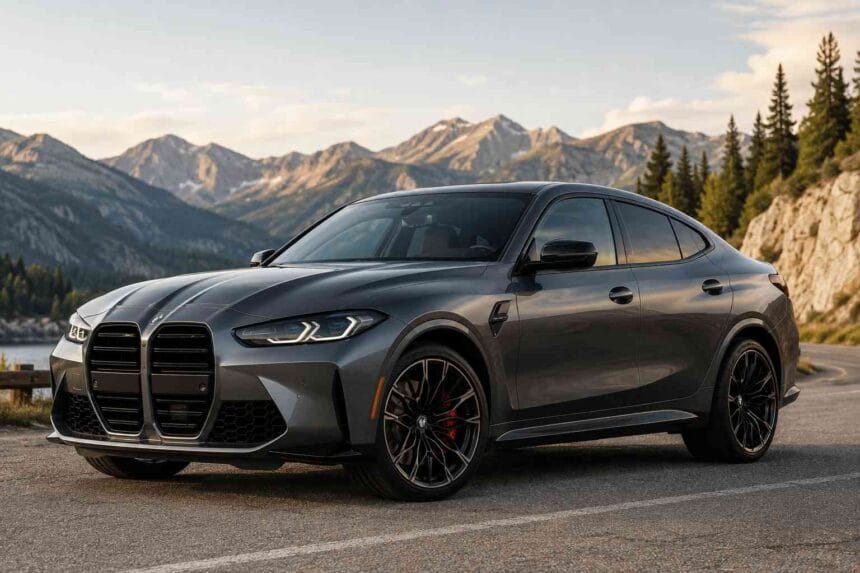
The BMVX4 sits at a fascinating crossroads: part compact luxury SUV, part fastback coupe and it pulls both identities off without compromise. Built on BMW’s CLAR platform with xDrive all-wheel drive standard across the lineup, it delivers between 248 and 503 horsepower depending on the variant you choose. Whether you’re cross-shopping for a daily driver or a weekend performance machine, this Sports Activity Coupe earns serious consideration in 2025, its final model year before BMW pivots the segment toward electrification.
- What Is the BMVX4?
- BMVX4 Generations and Model History
- BMVX4 Performance Levels and Engine Options
- BMVX4 M and M Competition
- Exterior Design and Road Presence
- Interior Comfort and Premium Materials
- Cargo Space and Everyday Practicality
- Infotainment and Connectivity
- Advanced Safety and Driver Assistance Technology
- Fuel Efficiency and Sustainability
- Driving Dynamics and xDrive All-Wheel Drive
- BMVX4 vs Competitors
- Ownership Costs, Pricing, and Value Retention
- Global Production and Sales
- Conclusion
- FAQs
- What is the BMVX4?
- Is the BMW X4 worth buying over the BMW X3?
- How fast is the BMVX4 M Competition?
- Does the BMVX4 come with all-wheel drive?
- What is included in the BMVX4 maintenance coverage?
- How does the BMVX4 compare to the Mercedes-AMG GLC Coupe?
- What engine options are available in the BMVX4?
- Is a hybrid or plug-in hybrid version of the BMVX4 available?
What Is the BMVX4?
BMW created the Sports Activity Coupe category to answer a specific demand: buyers who wanted SUV practicality without the upright, boxy silhouette. The X4 delivers that by grafting a fastback roofline onto an X3 platform — a concept BMW first tested with the larger X6.
Built at BMW’s Spartanburg, South Carolina facility on the CLAR platform — a mix of aluminium and high-strength steel — the vehicle is lighter and stiffer than earlier generations. It uses the same basic underpinnings as the G01 X3 but with a distinctly different personality. The iX4 electric successor is in development, making 2025 the final chapter for the combustion-powered generation.
BMVX4 Generations and Model History
First Generation (F26)
BMW debuted the F26 at the New York International Auto Show in 2014, following concept previews at Auto Shanghai 2013. Launch variants included the xDrive20i, xDrive28i, and xDrive35i on the petrol side, with xDrive20d, xDrive30d, and xDrive35d covering diesel buyers. The performance crown went to the M40i — producing 355 hp and 465 N⋅m, capable of 0–60 mph in 4.7 seconds.
BMW invested approximately $900 million into the Spartanburg plant specifically to accommodate X4 production. The F26 rode 23 mm lower than the X3 and sat 37 mm wider, giving it an immediately planted, road-hugging appearance.
Second Generation (G02)
Revealed in February 2018 and reaching dealerships that July, the G02 was a significant step up in every measurable dimension. It sat 52 mm taller, stretched 81 mm longer, and ran 37 mm wider than the F26 — yet weighed 50 kg less thanks to CLAR’s structural efficiency. The dual ball joint front axle and five-link rear setup improved both ride quality and handling precision simultaneously, something the previous generation struggled to balance.
iDrive 6.0, bi-LED headlights, and an automatic tailgate arrived as standard. In spring 2020, BMW added mild-hybrid support across key variants via a 48-volt system. The X4 M and X4 M Competition followed as separate performance models under the F98 designation, using the S58 straight-six — outputting 473 hp and 503 hp respectively. On the far end of the range, the Alpina XD4 used a quad-turbocharged B57 diesel producing 770 N⋅m of torque, enough to push the SUV to a 268 km/h top speed.
Production extended globally with assembly in Chennai (BMW India), Araquari, Rayong, Kulim, and Kaliningrad through partners including Avtotor and Bavarian Auto Group.
BMVX4 Performance Levels and Engine Options
xDrive30i — Balanced Everyday Performance
The entry point is far from basic. The xDrive30i pairs a 2.0L TwinPower Turbo inline-four with an 8-speed Sport Automatic transmission. It generates 248 horsepower and 258 lb-ft of torque, reaching 60 mph in 6.0 seconds — genuinely quick for a family-friendly crossover.
Chassis tuning here prioritizes composed cornering over outright sharpness, making it more usable in daily traffic than rivals like the Audi Q5 Sportback in base trim. The Mercedes-Benz GLC 300 Coupe offers a similar comfort balance but slightly less precision through corners.
M40i — Inline-Six with Mild-Hybrid Support
Step up to the M40i and the personality shifts noticeably. The 3.0L inline-six with 48V mild-hybrid assistance produces 382 horsepower and 369 lb-ft of torque. The 0–60 time drops to 4.4 seconds, placing it firmly in sports car territory for an SUV.
Adaptive M Suspension and M Sport Brakes are included. Three drive modes — Comfort, Sport, and Sport+ — adjust throttle response, suspension damping, and steering weight. The mild-hybrid system also recaptures braking energy, offering a small but meaningful improvement in real-world fuel consumption.
BMVX4 M and M Competition
The X4 M Competition represents what happens when BMW’s M division treats a crossover like a racecar. The 3.0L M TwinPower Turbo S58 engine puts out 503 horsepower in Competition trim and reaches 60 mph in 3.7 seconds — quicker than most sports cars. Standard X4 M produces 473 hp with a slightly softer setup.
Against the Mercedes-AMG GLC 43 Coupe and Audi SQ5 Sportback, the M Competition holds a clear edge in outright acceleration. The electromechanical rear differential and xDrive system distribute torque with track-level precision, not just all-weather traction.
Exterior Design and Road Presence
The sloping fastback roofline is the defining visual choice — and everything else is built around it. Sculpted body lines flow from the bold kidney grilles through to the muscular rear stance, creating a silhouette that reads as a coupe even when parked next to sedans.
Standard 19-inch alloy wheels fill the arches well. Optional M Performance Parts extend the customization significantly: carbon fibre mirrors, black kidney grilles, carbon fibre spoiler, and a front splitter are all available. Frozen Grey is among the more striking exterior finishes for buyers wanting something beyond metallic white or black.
Rear headroom measures 37.5 inches a real number worth noting given how much the roofline compresses space in some competitors.
Interior Comfort and Premium Materials
The cabin is driver-focused without making passengers feel like afterthoughts. Vernasca leather and SensaTec surfaces cover most contact points. The 14-way power front seats with 3-stage heating and ventilation cover most body types well, and lateral support during spirited driving is genuinely useful rather than decorative.
Ambient lighting, dual-zone climate control, an anthracite headliner, and panoramic moonroof are all available. Front legroom measures 40.7 inches — comparable to the best in the segment. The ergonomic precision of the driver’s cockpit — controls where you expect them, displays angled toward the driver — reflects years of refinement across BMW’s lineup.
Cargo Space and Everyday Practicality
| Configuration | Cargo Volume |
| Seats Up | 18.5 cubic feet |
| Seats Folded | 50.5 cubic feet |
The 40:20:40 split-folding rear seats allow flexible loading — three passengers can travel while a narrow cargo section remains open. The BMW X3 offers more cargo volume, but the X4’s 50.5 cubic feet is sufficient for family travel, luggage, or sports equipment. Weekend trips don’t require compromise.
Infotainment and Connectivity
Live Cockpit Professional brings dual 12.3-inch displays — one for the digital instrument cluster, one for the iDrive 7 touchscreen. Both are sharp and responsive.
Wireless Apple CarPlay, Android Auto, Amazon Alexa, Google Assistant, and ConnectedDrive services are all standard for 2025. A wireless charging pad, head-up display with windshield projection, and Bluetooth connectivity round out the tech stack. These features are now expected at this price point, and BMW meets or exceeds the standard.
Advanced Safety and Driver Assistance Technology
The Active Driving Assistant suite includes Frontal Collision Warning, City Collision Mitigation, Lane Departure Warning, and Active Blind Spot Detection. Parking Assistant Plus adds a surround-view camera.
The optional Driving Assistance Professional Package extends capability into semi-autonomous territory: Active Cruise Control with Stop & Go and Extended Traffic Jam Assistant handle low-speed motorway driving with minimal driver input. Euro NCAP testing returned 93% for adult occupant protection and 84% for child occupant protection — strong results for the segment.
Fuel Efficiency and Sustainability
The xDrive30i returns 28–29 MPG on the highway — reasonable given its performance output. The M40i benefits from the 48V mild-hybrid system’s brake energy regeneration and automatic start-stop, closing the efficiency gap slightly at real-world speeds.
No plug-in hybrid version is available for the X4. BMW EfficientDynamics technologies — lightweight CLAR construction, regenerative braking, Euro 6 compliance — do meaningful work, but buyers prioritizing efficiency over performance should note the Range Rover Evoque offers PHEV options in this price range.
Driving Dynamics and xDrive All-Wheel Drive
Intelligent xDrive monitors traction continuously, redistributing torque before wheelspin occurs rather than reacting after the fact. On wet or snow-covered roads, this creates a composed, planted feel that builds driver confidence quickly.
M Sport Differential and Adaptive M Suspension — available across M40i and standard on M variants — sharpen the dynamic picture further. The steering is direct without being nervous. Sport+ mode stiffens everything noticeably; most drivers will find Sport mode the better daily compromise. The sport exhaust on M trims produces a genuine acoustic reward, not a simulated one.
BMVX4 vs Competitors
| Model | Power | 0–60 mph | Starting Price |
| BMVX4 xDrive30i | 248 hp | 6.0 sec | $55,300 |
| Audi Q5 Sportback | 261 hp | 5.6 sec | $56,400 |
| Mercedes-Benz GLC 300 Coupe | 258 hp | 5.9 sec | $58,100 |
| Range Rover Evoque | 246 hp | 6.7 sec | $47,000 |
The X4 outperforms the Range Rover Evoque in handling and acceleration, while matching the GLC 300 Coupe in daily comfort. Against the Audi Q5 Sportback, the X4 offers stronger brand identity and a more driver-focused chassis. Interior materials across all four are competitive, but BMW’s ergonomic layout remains a standout.
Ownership Costs, Pricing, and Value Retention
| Variant | Starting Price |
| xDrive30i | $55,300 |
| M40i | $67,875 |
| X4 M | $79,100 |
BMW’s maintenance program covers factory-recommended service for 3 years or 36,000 miles — a real ownership advantage over some competitors that charge separately for routine maintenance.
As the final combustion-powered generation, 2025 X4 models may retain collector interest among enthusiasts who prefer the inline-six and M engine experience over upcoming electric alternatives.
Global Production and Sales
BMW assembled the X4 across multiple facilities worldwide. Key production numbers by year include:
| Year | Units Produced |
| Selected Year 1 | 21,688 |
| Selected Year 2 | 55,050 |
| Selected Year 3 | 66,792 |
Regional assembly ran through Araquari (Brazil), Rayong (Thailand), Kulim (Malaysia), and Kaliningrad (Russia) via Avtotor. The Bavarian Auto Group handled Egyptian market production. North American sales peaked in Q4 2023 according to BMW Group Annual Report data.
Conclusion
The BMVX4 closes out a successful chapter in BMW’s Sports Activity Coupe story. From the F26’s 2014 debut to the G02’s refined final form, it consistently delivered what competitors couldn’t: genuine driving engagement inside a practical, premium crossover body. The adaptive suspension, advanced digital cockpit, M-tuned engine options, and factory maintenance coverage combine into a strong value proposition — particularly at the M40i and M Competition levels. For buyers who want an athletic, visually bold crossover before BMW fully commits to electrification, this final generation is worth serious attention.
FAQs
What is the BMVX4?
The BMW X4 is a compact luxury crossover SUV classified as a Sports Activity Coupe. It combines a sloping fastback roofline with SUV practicality, xDrive all-wheel drive, and engines ranging from 248 hp to 503 hp.
Is the BMW X4 worth buying over the BMW X3?
If driving dynamics and exterior styling matter more than maximum cargo space, yes. The X4 sacrifices some rear headroom and luggage volume for a distinctly sportier character — both in looks and handling feel.
How fast is the BMVX4 M Competition?
It reaches 60 mph in 3.7 seconds using a 503 hp 3.0L M TwinPower Turbo S58 engine — faster than most sports sedans in its price range.
Does the BMVX4 come with all-wheel drive?
Yes. Every variant includes BMW’s intelligent xDrive all-wheel drive system as standard equipment.
What is included in the BMVX4 maintenance coverage?
BMW covers factory-recommended service for 3 years or 36,000 miles at no additional cost through its included maintenance program.
How does the BMVX4 compare to the Mercedes-AMG GLC Coupe?
The X4 M Competition outpaces the GLC 43 Coupe in acceleration and offers a more driver-focused chassis. The GLC counters with a slightly more luxurious cabin feel and broader powertrain options including PHEV variants.
What engine options are available in the BMVX4?
Three main options: a 2.0L TwinPower Turbo four-cylinder (248 hp), a 3.0L mild-hybrid inline-six (382 hp), and the M-specific 3.0L S58 producing 473 or 503 hp.
Is a hybrid or plug-in hybrid version of the BMVX4 available?
A 48V mild-hybrid system is available on the M40i, but no plug-in hybrid version exists. The iX4 electric model is the planned successor for the next generation.