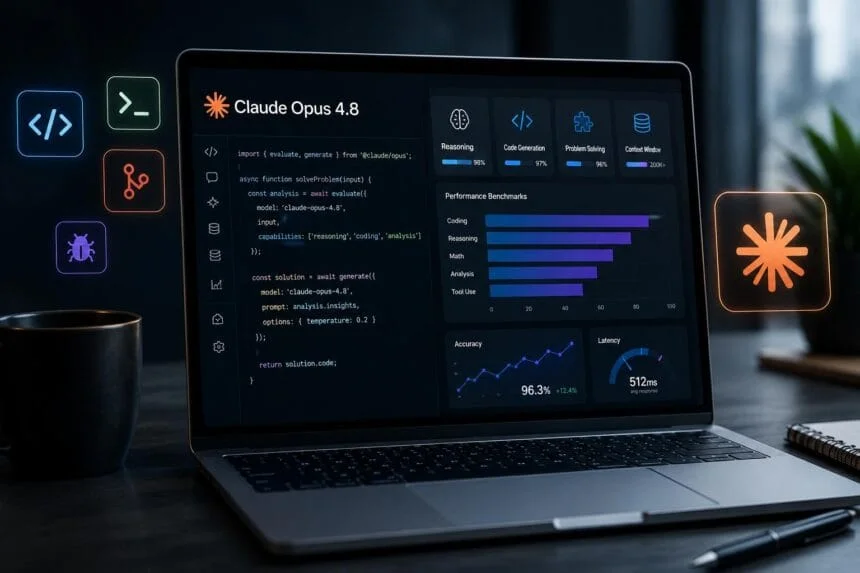
Quick Summary: What it is: Claude Opus 4.8 is Anthropic’s most capable, generally available model for coding, released May 28, 2026. Best for: Production-ready code generation, long-horizon agentic coding, codebase-scale migrations. Context window: 1M tokens (Claude API, Bedrock, Vertex AI) | 200k tokens (Microsoft Foundry) Pricing: $5/$25 per million input/output tokens unchanged from Opus 4.7 Key upgrade: 4x better self-error detection, parallel subagents, adaptive thinking, 2.5x fast mode
- Key Takeaways
- What Is Claude Opus 4.8? Anthropic’s Most Capable Coding Model Explained
- Claude Opus 4.8 Coding Benchmarks: How It Compares to GPT-5.5 and Gemini
- Terminal-Bench 2.1 and Agentic Coding Performance
- CursorBench — Tool Calling Efficiency Across Effort Levels
- Online-Mind2Web Computer Use and Browser Agent Scores
- Super-Agent Benchmark End-to-End Agentic Reliability
- Legal Agent Benchmark and Professional Knowledge Work
- Full Benchmark Comparison Table
- 5 Breakthrough Coding Capabilities in Claude Opus 4.8
- Long-Horizon Agentic Coding With Minimal Oversight
- Production-Ready Code Generation With Self-Error Detection
- Advanced Tool Calling Fewer Skipped Tool Calls
- Adaptive Thinking — Smarter Token Allocation Per Task
- Memory Across Sessions for Long-Running Coding Projects
- Coding Capability Summary
- Dynamic Workflows in Claude Code: Parallel Subagents for Large-Scale Coding Tasks
- Effort Control in Claude Opus 4.8: Matching Token Spend to Coding Task Complexity
- Fast Mode for Claude Opus 4.8 — 2.5x Speed for Coding Pipelines
- New API Features That Improve Coding Agent Workflows
- Mid-Conversation System Messages for Agentic Coding Loops
- Refusal Stop Details — Smarter Error Handling in Code Agents
- Lower Prompt Cache Minimum — 1,024 Tokens
- New API Features Summary
- API Constraints Developers Must Know Before Migrating to Opus 4.8
- Sampling Parameters Removed — No temperature, top_p, or top_k
- Extended Thinking Budgets Replaced by Adaptive Thinking
- Claude Opus 4.8 Pricing for Developers and Enterprise Coding Teams
- How to Migrate From Claude Opus 4.7 to 4.8 Without Breaking Your Coding Pipeline
- Real Developer Results: What Engineering Teams Are Building With Opus 4.8
- Claude Opus 4.8 vs GPT-5.5 vs Gemini 3.5 Flash: Which Is Best for Coding?
- Supported Coding Languages, Frameworks, and IDE Integrations for Claude Opus 4.8
- Claude Opus 4.8 Safety, Alignment, and Responsible Deployment for Coding Agents
- What’s Coming Next: Mythos-Class Models and the Future of AI Coding
- Conclusion
- Frequently Asked Questions About Claude Opus 4.8 for Coding
- When should I use Claude Opus 4.8 over Claude Sonnet or Haiku for coding?
- What coding benchmarks does Claude Opus 4.8 lead on?
- How does fast mode affect code generation quality in Opus 4.8?
- Can Claude Opus 4.8 handle full codebase migrations autonomously?
- What API parameters are no longer supported in Opus 4.8?
- How does Claude Opus 4.8 pricing compare for high-volume coding workloads?
- How do I migrate my existing Claude Opus 4.7 coding pipeline to Opus 4.8?
- Is Claude Opus 4.8 available on AWS, Google Cloud, and Microsoft Azure for enterprise coding?
Claude Opus 4.8 is Anthropic’s most capable generally available model for coding, released on May 28, 2026. It is a hybrid reasoning model built specifically for long-horizon agentic coding, production-ready code generation, and complex multi-step engineering tasks. With a 1M-token context window, adaptive thinking, and a new dynamic workflows feature in Claude Code, it represents a meaningful step forward from Opus 4.7 at the same price.
Key Takeaways
- Opus 4.8 is 4x less likely to let flawed code pass without flagging it compared to Opus 4.7
- Dynamic workflows enable hundreds of parallel subagents per Claude Code session
- Fast mode delivers 2.5x output speed, now 3x cheaper than fast mode on prior Opus models
- Sampling parameters (temperature, top_p, top_k) are unsupported; passing them returns a 400 error
- Adaptive thinking replaces extended thinking, budgets no code changes needed for most migrations
What Is Claude Opus 4.8? Anthropic’s Most Capable Coding Model Explained
Claude Opus 4.8 runs on the API model ID claude-opus-4-8 and supports up to 128k max output tokens. Its 1M-token context window is available by default on the Claude API, Amazon Bedrock, and Vertex AI, with a 200k-token limit on Microsoft Foundry.
| Specification | Detail |
|---|---|
| API Model ID | claude-opus-4-8 |
| Context Window | 1M tokens (API, Bedrock, Vertex AI) / 200k (Foundry) |
| Max Output Tokens | 128k |
| Thinking Mode | Adaptive thinking only |
| Release Date | May 28, 2026 |
| Pricing vs Opus 4.7 | Unchanged |
What separates it from previous releases is adaptive thinking: the model decides, per turn, whether to reason before answering. On simple lookups, it responds directly. On complex multi-step coding problems, it reasons first. This reduces wasted tokens on bimodal workloads without sacrificing output quality.
Anthropic describes it as designed for high-autonomy work: coding tasks where the model must plan, execute, verify, and iterate without constant human input.
Claude Opus 4.8 Coding Benchmarks: How It Compares to GPT-5.5 and Gemini
Benchmark Overview Opus 4.8 leads or matches frontier competitors across every major agentic and coding benchmark at the same or lower cost per task.
Terminal-Bench 2.1 and Agentic Coding Performance
On Terminal-Bench 2.1, scored using the Terminus-2 public harness, Opus 4.8 outperforms prior Opus models. GPT-5.5’s reported score using the Codex CLI harness sits at 83.4% — Anthropic reports Opus 4.8 exceeds that using the Terminus-2 standard. These are not directly comparable due to harness differences, but the gap is narrow at a similar cost.
Important Note: Terminal-Bench 2.1 scores for Opus 4.8 and GPT-5.5 use different harnesses (Terminus-2 vs. Codex CLI). Direct numerical comparison should be treated with caution.
CursorBench — Tool Calling Efficiency Across Effort Levels
On CursorBench, Cursor’s internal evaluation framework, Opus 4.8, exceeds prior Opus models across every effort level. Cursor co-founder Michael Truell noted that tool calling is meaningfully more efficient, as the model completes the same tasks in fewer steps. That directly reduces token spend on agentic coding pipelines.
Online-Mind2Web Computer Use and Browser Agent Scores
Opus 4.8 scores 84% on Online-Mind2Web, a meaningful jump over both Opus 4.7 and GPT-5.5. This benchmark measures computer-use and browser-agent reliability—the model’s ability to navigate and act autonomously within real interfaces. For engineering teams building agent products, that kind of end-to-end task reliability translates directly into fewer failures in production.
Super-Agent Benchmark End-to-End Agentic Reliability
On the Super-Agent benchmark, Opus 4.8 is the only model to complete every case end-to-end, beating prior Opus models and matching GPT-5.5 at parity on cost. The benchmark covers agent products across translation, deep research, slide-building, and analysis workflows.
Legal Agent Benchmark and Professional Knowledge Work
Opus 4.8 delivers the highest recorded score on the Legal Agent Benchmark and is the first model to break 10% overall on the all-pass standard. While that may sound narrow in isolation, Niko Grupen of Harvey called it the kind of accuracy lift that lets customers hand off substantial attorney work with confidence — a useful reference point for any high-stakes professional automation task.
Full Benchmark Comparison Table
| Benchmark | Claude Opus 4.8 | GPT-5.5 | Gemini 3.5 Flash |
|---|---|---|---|
| Terminal-Bench 2.1 (Terminus-2) | Leads field | 83.4% (Codex CLI) | — |
| Online-Mind2Web | 84% | Below Opus 4.8 | — |
| Super-Agent (end-to-end) | The only model to complete all cases | Parity, higher cost | — |
| Finance Agent v2 | Competitive | — | 57.9% |
| OSWorld-Verified | Above 82.3% (Opus 4.7 baseline) | — | — |
| Legal Agent Benchmark | Highest recorded score | — | — |
| Standard Pricing | $5/$25 per 1M tokens | Higher | Lower |
5 Breakthrough Coding Capabilities in Claude Opus 4.8
Long-Horizon Agentic Coding With Minimal Oversight
Opus 4.8 is built for coding tasks that span hours, not seconds. It handles larger codebases with better long-context retention, fewer compactions, and stronger recovery when compaction does occur. In practice, this means long agentic traces stay on task, the model doesn’t lose context or derail mid-task.
Anthropic confirmed it can carry out codebase-scale migrations across hundreds of thousands of lines of code, from kickoff through merge, using the existing test suite as its quality bar. That’s a materially different capability than single-file generation.
Pro Tip: For codebase migrations, set effort to xhigh in Claude Code and let the existing test suite serve as the pass/fail standard. Opus 4.8 uses it automatically as its completion bar; no additional instructions are needed.
Production-Ready Code Generation With Self-Error Detection
One of the most practically significant improvements is honesty. Opus 4.8 is around four times less likely than Opus 4.7 to let flaws in its own code pass without flagging them. Rather than confidently claiming completion on thin evidence, it proactively surfaces uncertainties and issues in its outputs, something prior models routinely missed.
Senior engineers can delegate harder coding work with that kind of self-correction loop in place.
Statistics Highlight: 4x How much less likely Opus 4.8 is to let code flaws pass unremarked vs. Opus 4.7. Source: Anthropic internal evaluations, Claude Opus 4.8 System Card
Advanced Tool Calling Fewer Skipped Tool Calls
A known issue in Opus 4.7 was skipping tool calls that tasks required. Opus 4.8 directly addresses this. Scott Wu, CEO of Cognition (maker of Devin), noted it uses tools cleanly, follows instructions consistently, and fixes the comment-verbosity and tool-calling issues from 4.7. For autonomous engineering workloads running unattended, that consistency matters significantly.
Adaptive Thinking — Smarter Token Allocation Per Task
With thinking: {type: “adaptive”} enabled, the model triggers reasoning only when the turn requires it. Simple lookups get direct answers. Complex multi-step problems get full reasoning chains. This reduces wasted thinking tokens on bimodal workloads compared to Opus 4.7 at the same effort level, without requiring any code changes.
Memory Across Sessions for Long-Running Coding Projects
Opus 4.8 maintains context across sessions, making it practical for multi-day engineering projects. Longer agentic traces remain coherent with improved compaction handling; the model recovers more cleanly when context is compressed, avoiding the mid-task derailments that affected earlier versions.
Coding Capability Summary
| Capability | Opus 4.7 | Opus 4.8 | Improvement |
|---|---|---|---|
| Self-error detection | Baseline | 4x more likely to flag | Major |
| Tool call reliability | Skips occurred | Fixed in 4.8 | Major |
| Codebase migration scale | Limited | Hundreds of thousands of lines | Major |
| Long-context retention | Good | Better compaction recovery | Moderate |
| Adaptive thinking | Per-session | Per-turn | Moderate |
Dynamic Workflows in Claude Code: Parallel Subagents for Large-Scale Coding Tasks
Feature Status: Research Preview Available on Enterprise, Team, and Max plans
Dynamic workflows are a new feature in Claude Code that allows Opus 4.8 to plan work and then spin up hundreds of parallel subagents in a single session.
How it works:
- Claude plans the full task and breaks it into subtasks
- Subtasks are distributed across hundreds of parallel subagents
- Subagents run concurrently; each can run longer with Opus 4.8
- Claude verifies all outputs before reporting back
The key use case is migrations: a single Claude Code session can take a large codebase from kickoff to merge, using the existing test suite as its pass/fail standard—no manual coordination between agents required.
Pro Tip: Dynamic workflows are most powerful when combined with the xhigh effort setting. Subagents inherit the effort level from the parent session — set it once at the top level.
Effort Control in Claude Opus 4.8: Matching Token Spend to Coding Task Complexity
| Effort Level | API Value | Claude Code Value | Best For |
|---|---|---|---|
| High (default) | high | high | Most coding tasks, balanced quality/tokens |
| Extra | extra | xhigh | Difficult tasks, async long-running workflows |
| Max | max | max | Highest quality, highest token spend |
| Low | low | low | Simple lookups, faster responses |
Opus 4.8 defaults to high effort on both the Claude API and Claude Code. At this level, it spends a similar number of tokens as Opus 4.7’s default, but with better performance. Anthropic has increased rate limits in Claude Code to accommodate higher effort levels.
Important Note: If you currently set effort explicitly, your setting carries over unchanged. The new default only affects API calls where effort was previously unset.
Fast Mode for Claude Opus 4.8 — 2.5x Speed for Coding Pipelines
Feature Status: Research Preview — Claude API only
Fast mode delivers up to 2.5x higher output tokens per second from the same model. Set the speed to “fast” in your API call to enable it.
| Mode | Input (per 1M tokens) | Output (per 1M tokens) | Speed |
|---|---|---|---|
| Standard | $5 | $25 | 1x |
| Fast mode | $10 | $50 | Up to 2.5x |
Statistics Highlight: Fast mode for Opus 4.8 is 3x cheaper than fast mode was for previous Opus models, making it viable for latency-sensitive pipelines that previously couldn’t justify the cost.
New API Features That Improve Coding Agent Workflows
Mid-Conversation System Messages for Agentic Coding Loops
Opus 4.8 now accepts “system” role messages immediately after a user’s turn in the messages array. This lets you update instructions mid-task, changing token budgets, permissions, or environment context without restating the full system prompt. Prompt cache hits from earlier turns are preserved, reducing input cost in long agentic loops—no beta header required.
Pro Tip: Use mid-conversation system messages to update token budgets dynamically as an agent progresses through a large coding task — without breaking the prompt cache or triggering a full re-route through a user turn.
Refusal Stop Details — Smarter Error Handling in Code Agents
When Claude declines a request, the stop_details object now includes the refusal category, in addition to the existing refusal stop reason. This makes it easier to route users or retry logic based on why a request was declined — useful for automated coding pipelines that need to distinguish between different classes of failed requests.
Lower Prompt Cache Minimum — 1,024 Tokens
The minimum cacheable prompt length drops to 1,024 tokens on Opus 4.8, down from a higher threshold on Opus 4.7. Prompts that were previously too short to cache can now create cache entries with no code changes. For coding agents with repeated system prompt structures, this reduces per-call input costs across high-volume workloads.
New API Features Summary
| Feature | What Changed | Developer Benefit |
|---|---|---|
| Mid-conversation system messages | role: “system” now accepted mid-array | Update agent instructions without breaking prompt cache |
| Refusal stop details | stop_details object now documented | Smarter error routing in automated pipelines |
| Lower prompt cache minimum | 1,024 tokens (down from higher threshold) | More prompts cache automatically, no code changes |
| Fast mode | speed: “fast” parameter | Up to 2.5x output speed at premium pricing |
API Constraints Developers Must Know Before Migrating to Opus 4.8
Warning: These constraints apply to the Messages API only. Claude Managed Agents are unaffected.
Sampling Parameters Removed — No temperature, top_p, or top_k
Setting temperature, top_p, or top_k to any non-default value returns a 400 error on Opus 4.8, same as on Opus 4.7. These parameters are not supported by the Messages API for this model. Use prompting to guide output variation instead.
Extended Thinking Budgets Replaced by Adaptive Thinking
Extended thinking budgets (thinking: {“type”: “enabled”, “budget_tokens”: N}) also return a 400 error. The only supported thinking mode is adaptive thinking.
Migration code change:
| Code | |
|---|---|
| Before (Opus 4.6 or earlier) | thinking = {“type”: “enabled”, “budget_tokens”: 32000} |
| After (Opus 4.7 and later) | thinking = {“type”: “adaptive”} + output_config = {“effort”: “high”} |
Claude Opus 4.8 Pricing for Developers and Enterprise Coding Teams
| Usage Type | Input (per 1M tokens) | Output (per 1M tokens) |
|---|---|---|
| Standard | $5 | $25 |
| Fast mode | $10 | $50 |
| With prompt caching | Up to 90% savings | — |
| With batch processing | 50% savings | 50% savings |
| US-only inference | 1.1x standard | 1.1x standard |
Opus 4.8 is available on the Claude Pro, Max, Team, and Enterprise plans via claude.ai, and natively on the Claude Platform via Amazon Web Services (Bedrock), Google Cloud (Vertex AI), and Microsoft Foundry.
Statistics Highlight: Databricks reported a 61% reduction in token cost versus Opus 4.7 for multimodal reasoning over PDFs and diagrams in their Genie agent, a concrete data point for teams evaluating per-task cost at scale.
How to Migrate From Claude Opus 4.7 to 4.8 Without Breaking Your Coding Pipeline
Migration Checklist
- Remove temperature, top_p, and top_k parameters from all API calls
- Replace thinking: {“type”: “enabled”, “budget_tokens”: N} with thinking: {“type”: “adaptive”}
- Add output_config = {“effort”: “high”} to replicate previous thinking depth
- Test prompt cache behavior — prompts above 1,024 tokens now cache automatically
- Review tool call logic — improved triggering may change flow in edge-case branches
- Update model string to claude-opus-4-8
- Verify effort level defaults — high is now the default on all surfaces
Pro Tip: The Claude API skill in Claude Code or the Agent SDK can apply many of these migration steps to your codebase automatically — no manual file-by-file edits required.
Real Developer Results: What Engineering Teams Are Building With Opus 4.8
Expert Insights
| Company | Result | Source |
|---|---|---|
| Cursor | Exceeds prior Opus models at every effort level on CursorBench; tool calls use fewer steps | Michael Truell, Co-Founder & CEO |
| Cognition (Devin) | Fixes comment-verbosity and tool-calling issues from 4.7; faster capability gains for engineers | Scott Wu, CEO |
| Databricks (Genie) | Deeper multistep questions at 61% lower token cost vs. Opus 4.7 | Hanlin Tang, CTO |
| Neural Networks Hebbian | Better citation precision and token efficiency on dense financial filings | Aabhas Sharma, CTO |
| Harvey | Highest score on Legal Agent Benchmark; first model to break 10% all-pass | Niko Grupen, Head of Applied Research |
These results span autonomous engineering, financial document workflows, legal agent automation, and deep research — all built on the same model.
Claude Opus 4.8 vs GPT-5.5 vs Gemini 3.5 Flash: Which Is Best for Coding?
| Benchmark | Claude Opus 4.8 | GPT-5.5 | Gemini 3.5 Flash |
|---|---|---|---|
| Terminal-Bench 2.1 (Terminus-2) | Leads | 83.4% (Codex CLI) | — |
| Online-Mind2Web | 84% | Below Opus 4.8 | — |
| Super-Agent (end-to-end) | Only the model that completes all cases | Parity, higher cost | — |
| Finance Agent v2 | Competitive | — | 57.9% |
| OSWorld-Verified | Above 82.3% baseline | — | — |
| Standard pricing | $5/$25 per 1M tokens | Higher | Lower |
Pros and Cons vs. Alternatives
Claude Opus 4.8
Pros: Strongest agentic coding reliability; best self-error detection; parallel subagents; same pricing as 4.7; 1M context
Cons: No sampling parameters; fast mode is research preview only; Microsoft Foundry is limited to 200k context
For coding specifically, Opus 4.8’s strongest differentiators are long-horizon agentic task completion, self-error detection, and tool call reliability — areas where benchmark scores and real-world developer reports align.
Supported Coding Languages, Frameworks, and IDE Integrations for Claude Opus 4.8
Opus 4.8 has no published language restriction list — it handles general-purpose code generation, refactoring, debugging, test generation, and code review across mainstream languages and frameworks.
Integration Paths
| Integration | Use Case | Plan Required |
|---|---|---|
| Claude Code (CLI) | Agentic coding, dynamic workflows, migrations | Team / Enterprise / Max |
| Claude Code for VS Code | IDE-native coding agent | All plans |
| Claude Code for JetBrains | IDE-native coding agent | All plans |
| Claude API (direct) | Custom pipelines, claude-opus-4-8 | Developer / API access |
| Agent SDK | Multi-agent coding pipelines | Developer / API access |
| Amazon Bedrock | Enterprise AWS deployments | Enterprise |
| Google Vertex AI | Enterprise GCP deployments | Enterprise |
| Microsoft Foundry | Enterprise Azure deployments (200k ctx) | Enterprise |
Pro Tip: CI/CD pipeline integration is possible via the API. Teams running automated code review, migration checks, or test generation can call Opus 4.8 directly within existing workflows using the claude-opus-4-8 model string.
Claude Opus 4.8 Safety, Alignment, and Responsible Deployment for Coding Agents
Before release, Anthropic’s Alignment team conducted a detailed assessment. Key findings:
- Opus 4.8 reaches new highs on prosocial traits — supporting user autonomy and acting in the user’s best interest
- Rates of misaligned behavior (including deception) are substantially lower than Opus 4.7
- Alignment is comparable to Claude Mythos Preview — Anthropic’s most aligned model
Expert Insight: For coding agent deployments specifically, the model’s reduced tendency toward unsupported claims and proactive error flagging are functionally important safety properties — particularly for autonomous workflows running without human review.
The full Claude Opus 4.8 System Card covers safety results, pre-deployment safety tests, and alignment evaluations in depth. Project Glasswing currently restricts higher-capability Mythos Preview to a small number of trusted organizations for cybersecurity work, pending stronger cyber safeguards before general availability.
What’s Coming Next: Mythos-Class Models and the Future of AI Coding
Anthropic has confirmed plans to release models with higher intelligence than the current Opus tier.
| Model | Status | Availability |
|---|---|---|
| Claude Opus 4.8 | Generally available | All plans, all cloud providers |
| Claude Mythos Preview | Limited via Project Glasswing | Trusted orgs, cybersecurity focus only |
| Mythos-class (general) | In development | Expected within weeks of May 2026 |
| Lower-cost Opus-capability model | In development | — |
Conclusion
Claude Opus 4.8 for coding represents the current frontier for production-ready code generation, long-horizon agentic tasks, and autonomous engineering workflows. With a 1M-token context window, parallel subagents via dynamic workflows, adaptive thinking, and materially improved tool-call reliability, it handles coding tasks that prior models couldn’t sustain. Use claude-opus-4-8 via the Claude API, Claude Code, or your existing cloud provider. For teams currently on Opus 4.7, migration is low-friction, and the upgrade is worth it.
Final Summary Best model for: Production code, codebase migrations, long-horizon agents, multi-day engineering projects | Biggest improvements over 4.7: 4x better self-error detection, parallel subagents, fixed tool calling, adaptive thinking per-turn | Migration effort: Low — remove sampling params, switch thinking mode, update model string | Pricing: Unchanged from Opus 4.7 at $5/$25 per 1M tokens; fast mode at $10/$50 | Get started: claude-opus-4-8 via Claude API, Claude Code, AWS Bedrock, GCP Vertex AI, or Microsoft Foundry
Frequently Asked Questions About Claude Opus 4.8 for Coding
When should I use Claude Opus 4.8 over Claude Sonnet or Haiku for coding?
Use Opus 4.8 for production-ready code generation, sophisticated AI agents, and demanding tasks where frontier intelligence is required. Claude Sonnet covers most everyday coding tasks at a lower cost. Haiku suits lightweight, high-volume, latency-sensitive completions.
What coding benchmarks does Claude Opus 4.8 lead on?
Opus 4.8 leads on Terminal-Bench 2.1, CursorBench across all effort levels, Online-Mind2Web (84%), and the Super-Agent benchmark, where it’s the only model to complete every case end-to-end. It also holds the highest score on the Legal Agent Benchmark.
How does fast mode affect code generation quality in Opus 4.8?
Fast mode delivers up to 2.5x higher output tokens per second. It’s a research preview — Anthropic hasn’t published coding-specific quality comparisons between fast and standard mode, so it’s best suited for latency-sensitive pipelines where speed is prioritized over maximum output precision.
Can Claude Opus 4.8 handle full codebase migrations autonomously?
Yes. Via dynamic workflows in Claude Code, Opus 4.8 can run hundreds of parallel subagents in a single session, executing codebase-scale migrations across hundreds of thousands of lines of code from kickoff to merge, using the existing test suite as the completion bar.
What API parameters are no longer supported in Opus 4.8?
temperature, top_p, and top_k are unsupported — passing non-default values returns a 400 error. Extended thinking budgets (budget_tokens) are also removed. Use adaptive thinking with the effort parameter instead.
How does Claude Opus 4.8 pricing compare for high-volume coding workloads?
Standard pricing is $5 per million input tokens and $25 per million output tokens. With prompt caching, you can save up to 90% on repeated input. Batch processing saves 50%. Fast mode costs $10 or $50 per million tokens. US-only inference adds 1.1x.
How do I migrate my existing Claude Opus 4.7 coding pipeline to Opus 4.8?
Remove unsupported sampling parameters, replace extended thinking with thinking: {“type”: “adaptive”}, and switch to the claude-opus-4-8 model string. Most behavioral changes require no code changes. The Claude API skill can automate migration steps directly in your codebase.
Is Claude Opus 4.8 available on AWS, Google Cloud, and Microsoft Azure for enterprise coding?
Opus 4.8 is available on Amazon Bedrock, Google Cloud’s Vertex AI (both with 1M token context), and Microsoft Foundry (200k token context). Enterprise teams can also use US-only inference at 1.1x pricing for data residency compliance.